
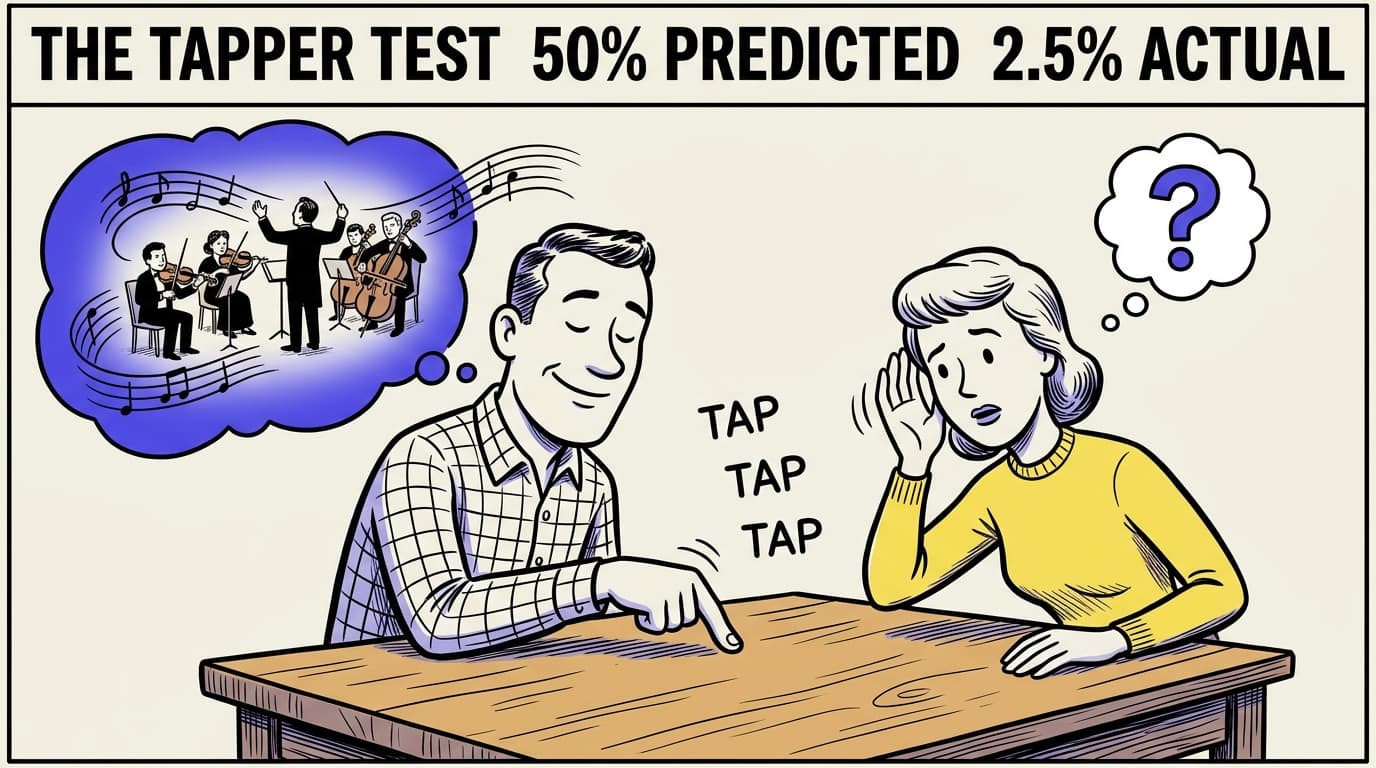
You read your landing page and hear the full melody of what you built. A stranger reads the same page and hears taps on a table. The 1990 Stanford tapper experiment measured that gap: tappers predicted 50% of listeners would identify the song they were tapping. The actual rate was 2.5% (Newton, n=120 listeners, via Heath and Heath, Made to Stick). That 20x prediction error is the founder's view of their own page. The visitor is the listener. The gap between the two is where conversions die.
Three cognitive biases keep founders inside it. The curse of knowledge (Camerer, Loewenstein and Weber, 1989) means you cannot accurately model the judgment of someone who does not know what you know. The IKEA effect (Norton, Mochon and Ariely, 2011) means you value the page you built about 63% higher than an equivalent page you didn't. The false consensus effect (Yates and Pothbury, 2024, n=714 marketing executives) means more than 70% of marketers project their own preferences onto buyers and reject contradicting data. The combined effect is structural. No amount of effort or rewriting from inside the lock will fix it.
This article covers what the tapper experiment actually measured, why the three biases compound rather than cancel out, what a stranger actually sees on a landing page, why peer feedback never surfaces the real problem, and the three diagnostic methods that work because they replace your perspective rather than train it.
The tapper test: why you hear a melody and they hear noise
In 1990 a Stanford PhD student named Elizabeth Newton split participants into "tappers" and "listeners". The results have been quoted ever since because they did not flatter anybody.
Tappers picked a well-known song and tapped its rhythm on a table. Listeners tried to identify the song. Before the experiment, tappers predicted that listeners would guess correctly about 50% of the time. The actual success rate was 2.5%. Three out of 120.
2.5%
Listeners who identified the song. Tappers predicted 50%. A 20x prediction gap. Newton, 1990 (Stanford), via Heath and Heath, Made to Stick
The tappers were frustrated. The song was obvious. How could the listeners not hear it? The answer is that the tappers literally could not stop hearing the melody in their own head while they tapped. They were neurologically incapable of experiencing the taps as the listener did, stripped of all context, stripped of the melody, just isolated knocks on a table.
This is what happens when you read your own landing page. You wrote "Accelerate your revenue operations pipeline" and you hear the full story: the integrations, the workflow engine, the three months of customer discovery, the named customer you built it for. A stranger reads the same five words and hears taps. They do not know what revenue operations means. They do not know what your pipeline does. They do not know why they should care. The melody is only in your head, and you are physically unable to stop hearing it.
The bias is not effort-sensitive. Camerer's 1989 paper found that even paying participants for accurate predictions about uninformed peers reduced the bias by only about 50%. It did not eliminate it. You can read your headline a thousand times with a stopwatch and a coffee. You still cannot read it as someone who has never heard of your product.
The triple lock: three biases that compound
The tapper experiment isolates one bias. Founders operate under three at once, and the three multiply.
Bias one: the curse of knowledge
Once you possess information, you cannot accurately simulate the judgment of someone who does not have it (Camerer, Loewenstein and Weber, 1989). The classical effect size: tappers off by 20x. In landing-page work this shows up as headlines that read as clear to the author and as gibberish to the reader. You wrote the words. You cannot read them clean.
Bias two: the IKEA effect
Norton, Mochon and Ariely demonstrated in 2011 that people pay 63% more for products they assembled themselves and rate amateur work they built as comparable in value to expert work. Each rewrite of your hero section makes the page feel more "right" to you, regardless of whether it communicates better to anyone else. The labour you invested inflates your perception of quality. The twelfth rewrite is not closer to clarity. It is twelve times more sunk-cost weight you are carrying into the next read.
63%
more that creators pay for their own work vs. equivalent pre-assembled items. Norton, Mochon and Ariely, 2011 (Harvard/Yale/Duke)
Bias three: the false consensus effect
A 2024 review of 714 marketing executives found that over 70% project their own preferences onto consumers. When data contradicts their assumptions, they are more likely to discount the data than update the belief. This is the bias that makes user-test transcripts feel like outliers. A stranger says "I don't understand what this does" and the founder's instinct is to explain it, not to change the page. Because to the founder, it is already clear.
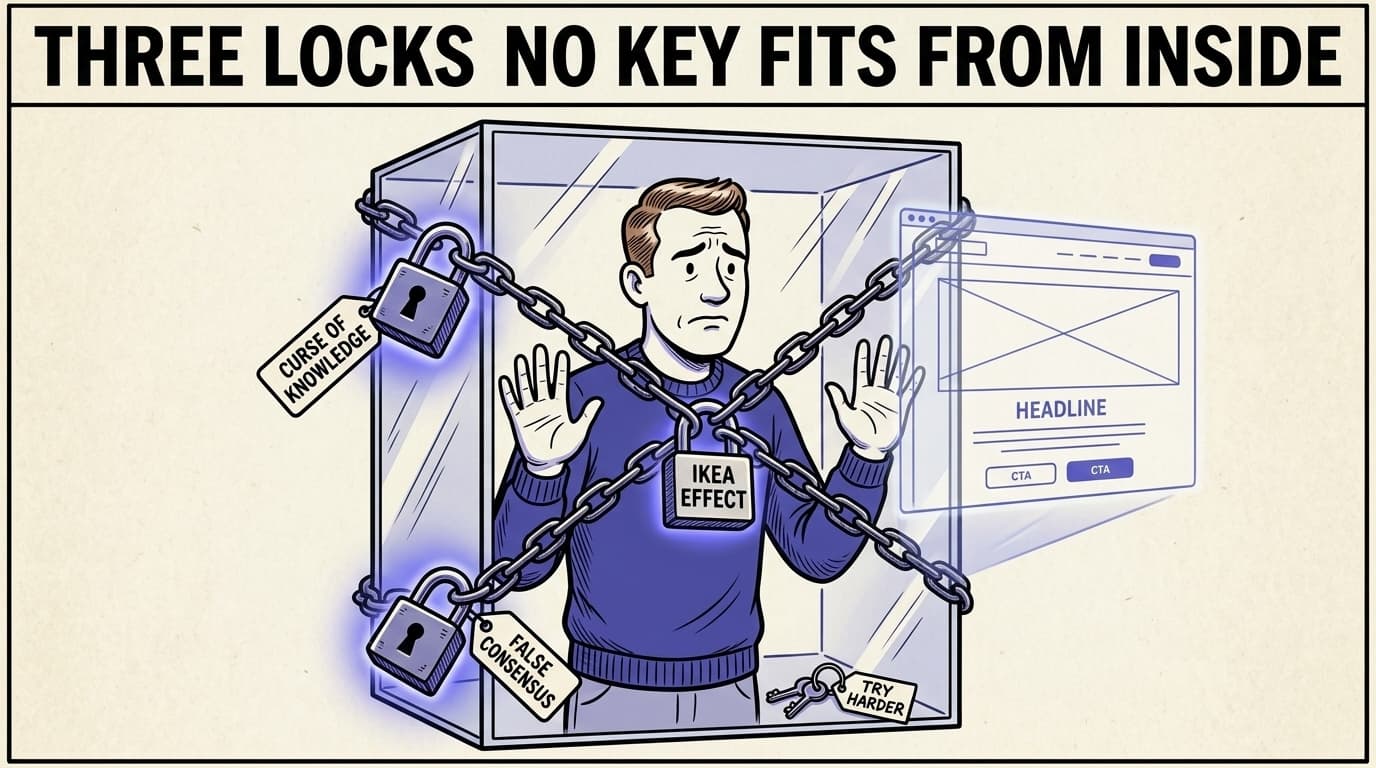
Each bias on its own is hard to dislodge. Together they form what cognitive science researchers call a "self-confirming cognitive trap". You cannot read your own page accurately (curse of knowledge), you overvalue every iteration of it (IKEA), and when a stranger tells you it does not work you discount their feedback (false consensus). Three locks. No key fits from inside.
Key takeaway
The triple lock is structural, not motivational. Reading your page more carefully does not solve it. The fix is replacing your reader, not improving yours.
What a stranger actually sees (vs. what you think they see)
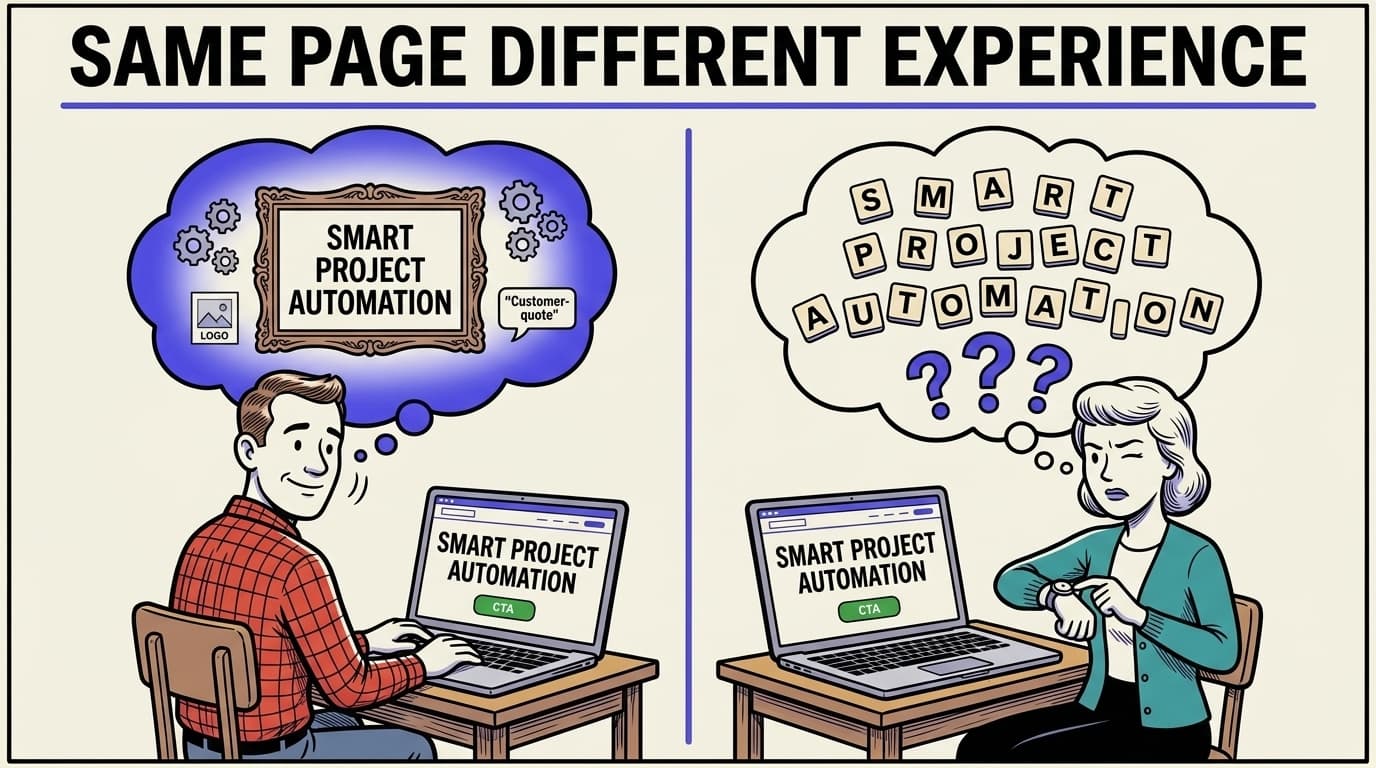
Consider a typical SaaS hero block. The headline is "Smart Project Automation". There are four feature icons under it with labels. There is a green "Get Started" button. There is one testimonial. Here is the same hero through two different readers.
What the founder reads
"Smart Project Automation" is the workflow engine we spent three months building, the one that integrates with Jira, Linear and Notion.
Feature icons each map to a real capability with a customer story behind it.
"Get Started" is the moment they sign up, see the dashboard, connect their tools and feel the value land.
The testimonial is from our best beta user who saved ten hours a week.
What the stranger reads
"Smart Project Automation" could mean six different things. Project management tool? Automation platform? AI product?
Feature icons are small pictures with labels I have no context to evaluate.
"Get Started" with what, how long, what does it cost, what do I need to install?
The testimonial is a name I do not recognise saying something vague about saving time.
The gap between these two readings is where conversions die. The founder filled in every blank with months of context. The stranger has no blanks to fill. They take the page at face value, and at face value, the page communicates almost nothing.
The timing makes it worse. 55% of visitors spend less than 15 seconds on a website (Microsoft attention study, 2015). Visual impressions form in 50 milliseconds (Lindgaard et al., 2006). At those speeds, the stranger is not working to understand the page. They are scanning for one of three confirmations: what is this, who is it for, why should I care. If the first screen does not deliver all three, they leave. Not because they were uninterested. Because the page gave them nothing to hold onto.
You think 50% of visitors understand your headline. The research says the real number is closer to 2.5%.
Why peer feedback does not fix this
Founders ask other founders for feedback. r/SideProject, Indie Hackers, Twitter, founder Slacks. The feedback is structurally the wrong kind.
Fellow founders are builders. They understand SaaS. They understand product categories. When they look at your landing page, they fill in the same context gaps you do. They notice design quality, copy style, layout. They do not notice comprehension failures, because they already comprehend. The feedback you get back is "love the colours, great layout, maybe tighten the headline a bit" when the actual problem is "I have no idea what this product does or who it is for".
This creates a feedback loop that preserves the status quo. You receive positive signals from people who are not your customers. You interpret "looks good" as "communicates clearly". You conclude the page works and the conversion problem must be traffic, pricing or product-market fit. The page was never the suspect because everyone who looked at it said it was fine. But "everyone" was other builders, not the confused stranger from Google who bounced in three seconds.
There is also a structural timing problem. Founders typically ask for feedback after they have already invested significant effort. At that point both the asker and the reviewer are biased toward confirmation. Criticism feels like wasted work to one and unkind to the other. Positive feedback feels like validation to one and supportive to the other. The result is feedback that protects the relationship rather than identifies the problem.
46-400%
conversion lift from voice-of-customer copy rewrites that replace internal language with the words customers use in reviews and tickets. CXL, Copyhackers, SEON, Voices.com case studies
The feedback you need is from someone who has never heard of your product, has no context about your category, and has eight seconds of attention. That person will not comment on your colour palette. They will tell you whether they understood what you do. If they cannot, you have found the conversion problem that peer feedback will never surface.
How to see your page through stranger eyes
You cannot remove your own biases. The research is unambiguous on this point: 35 years of follow-up studies after Camerer's original paper have failed to find a training intervention that reliably eliminates the curse of knowledge.
The productive approach is not to try harder to be objective. It is to replace your perspective with someone else's. Three methods work.
Method one: the hallway test
Find someone who has never seen your product. Not a friend. Not a fellow founder. A coworker from a different department, a family member who does not work in tech, a stranger at a coffee shop willing to give you 30 seconds. Show them the landing page. Do not explain anything. Watch where their eyes go. After 10 seconds, ask: what does this do, who is it for, why would someone use it. Their answer is the truth about your page. Your answer is the melody only you can hear. Run this with five people in your target audience and the pattern across their answers is your actual headline brief.
Method two: the 48-hour gap
Close the tab. Do not look at your landing page for two full days. Work on something else. When you come back, open the page and read only the first screen. Do not scroll. Try to read it as if you have never seen it before. You will not fully succeed, because the curse of knowledge does not expire. But familiarity bias weakens with distance. The phrases that felt "clear" two days ago will start to feel abstract. That flicker of uncertainty is signal. Mark every phrase where you feel it. Your visitor feels it on every visit, every time.
Method three: multi-persona simulation
Run a wide set of visitor archetypes through the page in parallel. A price-sensitive buyer. A skeptical researcher. A technical evaluator. An accidental visitor who clicked through from social. A returning user who already bookmarked you. Each archetype carries different prior knowledge, different goals, different skepticism, and different tolerance for ambiguity. The failures that appear across multiple archetypes are the ones to fix first, because they affect the largest share of real visitors.
The third method is what WhyIQ does. It simulates 50 first-time visitors against your page, each with zero prior context about your product. No melody. Only taps. The output is not "your page looks good". It is "this archetype could not identify what you do, this one did not trust the proof, and this one left because the headline used jargon they did not know". Different strangers. Different failures. The view from outside the triple lock.
The checklist: four moves you can run this week
None require an A/B testing tool. All of them work because they replace the reader, not the writer.
1. Run a five-person hallway test. Five strangers, 10 seconds each, one question per stranger: "what does this do?". Write down the verbatim answer. If three out of five cannot answer specifically, your headline does not communicate. Industry surveys suggest fewer than 17% of founders A/B test at all, and even fewer run any form of unmoderated comprehension test. The hallway test is free and produces a stronger signal than most paid tools.
2. Read your hero copy out loud. Slowly. Once a week. Things that read as smart on screen often read as vague when spoken. The ear catches vagueness the eye trained itself to skim past.
3. Mine the language of your customers. Pull 50 review excerpts, support tickets or sales-call transcripts. Find the phrases customers actually use to describe their problem and your product. Compare them against your hero. If the words do not overlap, your page is written in your vocabulary, not theirs. Voice-of-customer rewrites are the source of the 46-400% conversion lifts in the published case studies for a reason: the language gap is rarely small.
4. Run an outsider simulation. A multi-persona simulation against your page exposes which archetypes fail, where they fail and why. Stronger than peer review because the archetypes have no incentive to be polite. Stronger than a hallway test because you can run 50 simulated visitors in 10 minutes instead of 5 people in a week.
The underlying methodology this article relies on is documented in our science page. The broader category of running these diagnostics before a page has any traffic at all is what we call pre-traffic CRO.
Frequently asked questions
Why can't I see what's wrong with my own landing page?
Three cognitive biases compound. The curse of knowledge (Camerer, Loewenstein and Weber, 1989) means you cannot accurately simulate the judgment of someone who does not know what you know. The IKEA effect (Norton, Mochon and Ariely, 2011) means you value the page you built about 63% higher than an equivalent page you did not. The false consensus effect (Yates and Pothbury, 2024) means you project your own comprehension onto visitors and discount evidence to the contrary. These are not effort problems. They are how human cognition works. The only fix is replacing your perspective with someone else's.
What is the curse of knowledge in marketing?
The curse of knowledge is a cognitive bias identified by Camerer, Loewenstein and Weber in 1989. Once you know something, you cannot simulate not knowing it. Elizabeth Newton's 1990 Stanford experiment quantified it: tappers predicted 50% of listeners would identify the song they were tapping. The actual rate was 2.5%, a 20x gap between what tappers thought they communicated and what listeners actually received. The same gap operates between founders reading their own landing page and strangers reading it for the first time.
How do I get objective feedback on my landing page?
Three methods work. The hallway test: show the page to five strangers in your target audience, 10 seconds each, ask one question ("what does this do?"). The 48-hour gap: close the tab for two days, then read only the first screen as if you had never seen it. Multi-persona simulation: run 50 simulated visitors, drawn from 21 different archetypes, against the page to identify which segments fail and why. Critically, get feedback from people with no prior context about your product, not from fellow founders who fill the same context gaps you do.
Why do my friends say my landing page looks good but nobody converts?
Your friends are builders, not your customers. They fill in the same context gaps you do, and they have a social incentive to be supportive. Builder communities reward craft. Customer communities reward clarity. The phrase "looks good" measures aesthetic judgment. The phrase "converts well" measures communication effectiveness. They are different skills measuring different things. The feedback you need comes from people who have never heard of your product and have eight seconds to give it.
Should I hire a CRO consultant to review my landing page?
A CRO consultant helps if they use a structured diagnostic method. A designer will notice design problems. A copywriter will notice copy problems. A CRO specialist using persona-based analysis will identify which visitor archetypes fail and why. The most common mistake is asking friends or fellow founders for feedback instead of running one of these. They fill in the same context gaps you do and produce aesthetic comments rather than comprehension diagnoses.
What is the hallway test?
The hallway test, popularised in Joel Spolsky's 2000 essays on usability, is the practice of showing a product or page to people who happen to be nearby ("in the hallway") rather than to recruited testers. For landing pages, the practical version is: find five strangers in your target audience, show them the page for 10 seconds, ask "what does this do?" and "who is it for?". Three or more vague or wrong answers means the page does not communicate. The technique is free, fast and produces a higher-signal output than most paid feedback tools because the testers have no incentive to be polite.
Does running A/B tests fix the founder bias problem?
Not on its own. A/B testing measures which version performs better. It does not generate the hypotheses you test. If your hypothesis pool comes from inside the triple lock, your tests will measure variations of the same blind spot. Roughly 14% to 20% of A/B tests reach statistical significance, and most failed tests trace to weak hypotheses, not weak execution. A/B testing is downstream of comprehension. Fix the comprehension layer first using outsider perspective, then test the candidates that survive.
What is multi-persona landing-page simulation?
Multi-persona simulation is the practice of running a large set of synthetic visitor archetypes (typically 20 to 50) against a landing page in parallel and reporting which archetypes converted, which bounced, and why. Each archetype carries different prior knowledge, goals, skepticism levels and tolerance for ambiguity, so the output identifies which visitor segments the page fails for, rather than producing a single average score. It is structurally different from heatmaps or session recordings, which observe what happened but cannot explain why.
Go deeper
For the eight-signal scoring model that drives the simulation, see the AI Citability Playbook for the citation side, and CRO audits are broken for the broader case against behavioural-observation-only diagnostics.