
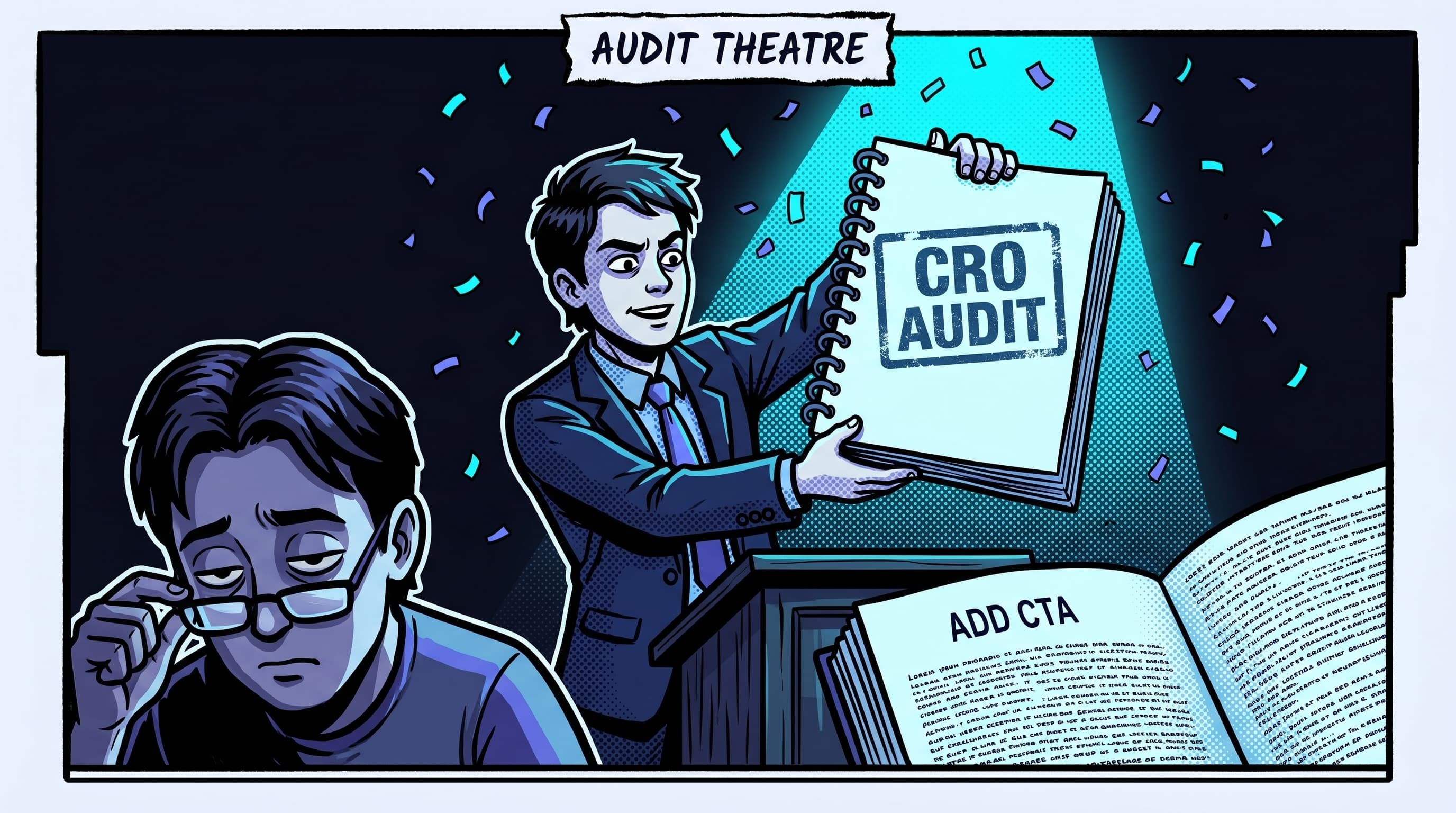
A client pays your agency $3,000 for a landing page audit. You install Hotjar, watch sessions for two weeks, screenshot some heatmaps, and deliver a 60-page PDF. The recommendations include "make the CTA more prominent" and "add social proof above the fold". The client implements three of them. Conversion does not move. They do not renew.
You did the work. The deliverable looked impressive. The numbers did not move. This is not a you problem. It is a methodology problem. And it has been quietly costing the entire CRO industry retainers for about a decade.
Heatmaps tell you a visitor clicked. They cannot tell you why they left. That gap is the entire difference between an audit and a diagnosis.
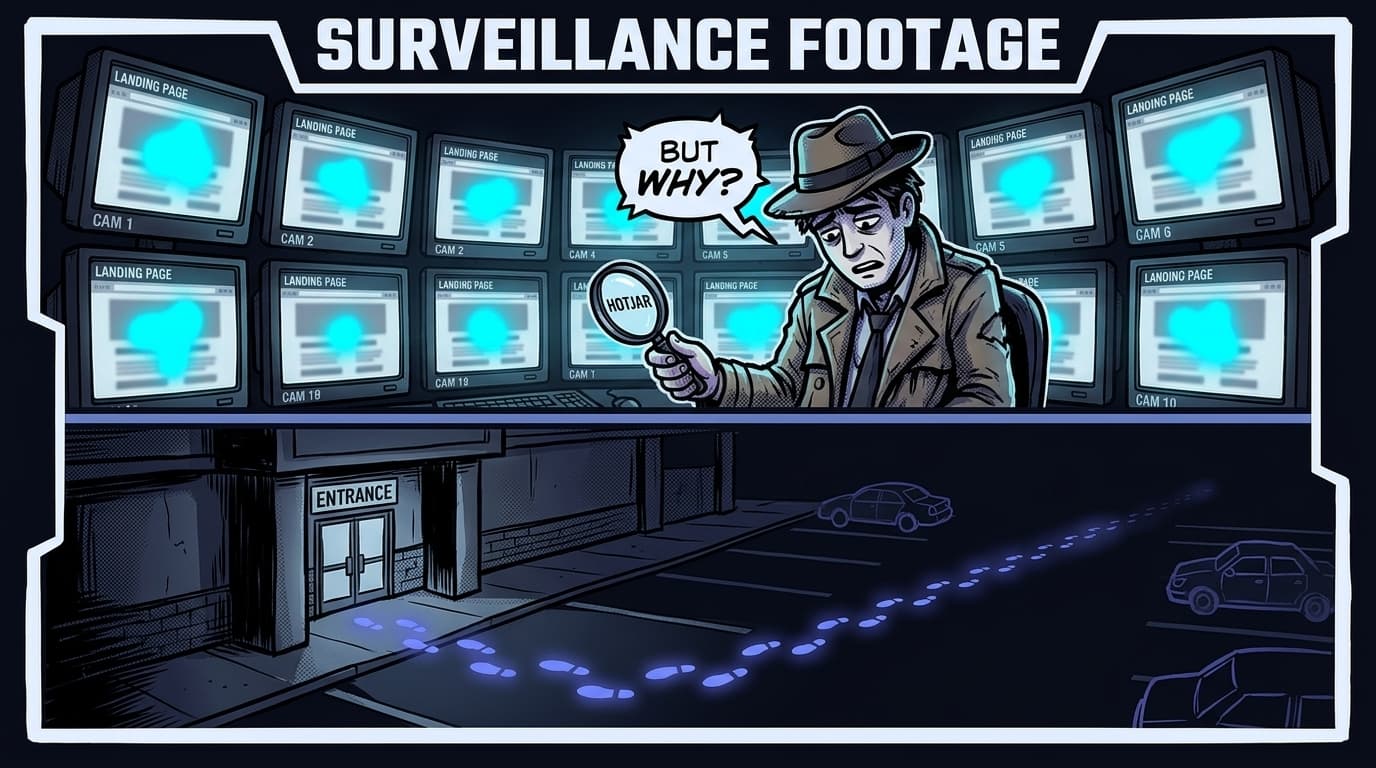
The CRO audit industry is built on behavioural observation. The tools are excellent at what they do. Hotjar, FullStory, Microsoft Clarity, Lucky Orange. They show what happened on the page with surgical precision. The problem is that "what happened" is not a diagnosis. It is surveillance footage. Surveillance footage is great for proving someone was in the building. It is terrible at explaining why they left, what they wanted, and who they thought you were when they walked in.
What you are actually selling for $3,000
The methodology is consistent across the industry. The output is thorough. The diagnostic model is incomplete.
A typical CRO audit goes like this. Install the analytics stack. Collect two to four weeks of behavioural data. Generate heatmaps and scroll maps. Watch session recordings. Cross-reference with Google Analytics. Compile findings into a slide deck or PDF. Mid-tier audits cost $990 to $1,540 as one-time engagements. Enterprise audits run $15,000 to $30,000. Monthly retainers go from $2,000 to $31,000. Clients additionally pay $200 to $1,500 a month for the tools themselves. The PDF is usually 60 to 90 pages.
$990-$30,000
Range for a CRO audit. Plus $200-$1,500 a month for tools. Tenet, Convert, Glued, Invesp 2025
The deliverable looks impressive. The data is real. The screenshots are annotated. The recommendations are the problem. They follow a checklist that has not meaningfully changed since 2018. Improve headline clarity. Make the CTA more prominent. Add social proof above the fold. Reduce page load time. Optimise for mobile. These are not wrong. They are also not specific. They could apply to any page, for any product, with any visitor mix. The same checklist appears on report after report because the framework that produced it is identical regardless of who the client is.
The client does not notice this on audit number one. They notice it on audit number three, when your competitor's report says the same five things yours did, and a third agency they consulted says the same five things again. At that point your "diagnosis" looks like a generic template with their logo on the front cover. Which, structurally, is what it is.
Heatmaps are surveillance footage. They are not detective work.
Heatmaps have ten documented limitations, and the most damaging one is that they cannot tell the difference between confusion and engagement.
A cluster of clicks on an element, what Jakob Nielsen famously called a "big red blob", tells you visitors interacted with it. It does not tell you whether they were interested, confused, frustrated, or trying to click something they thought was a link but was not. The click is the same. The motivation behind it is wildly different. And the fix depends entirely on the motivation, not the click.
Optimizely's own documentation states that heatmap insights are "usually obvious and non-actionable". Scroll maps can be actively misleading. They show where visitors stopped scrolling. The reason for stopping could be that they found what they needed, got bored, ran out of time, or read the layout as "there is nothing more below this fold so I will leave now". Three different causes, three completely different fixes, one identical data point on the heatmap.
14-20%
of A/B tests reach statistical significance. The rest are statistical noise. CXL analysis of 28,304 experiments
Mouse position does not equal visual attention either. Eye-tracking research has been clear on this since the early 2000s. Visitors move their mouse on one part of the screen while reading content somewhere else entirely. Small sample sizes create patterns that look meaningful and are not. And heatmaps aggregate every visitor into one view, erasing the differences between visitor types that are usually the actual story. A heatmap of 1,000 visitors shows an average. The average does not tell you that price-sensitive buyers behaved completely differently from technical evaluators, or that skeptical researchers were focused on a different section of the page than impulse-action visitors. The average is a fiction. It is the fiction your audit is built on.
A recommendation without a causal explanation is a guess. Most audit recommendations are guesses with confidence.
"Add social proof above the fold" appears in nearly every CRO audit ever delivered. It is probably correct. It is also useless without context. Which visitors need social proof? What kind? A named customer testimonial, a logo strip, a usage number, a case study, a star rating, a quote? The answer depends entirely on who is visiting the page and what makes them skeptical. A price-sensitive buyer needs proof the product is worth the cost. A technical evaluator needs proof the product actually works. A skeptical researcher needs proof from someone other than the vendor. A first-time buyer in a regulated industry needs proof there will not be a compliance disaster.
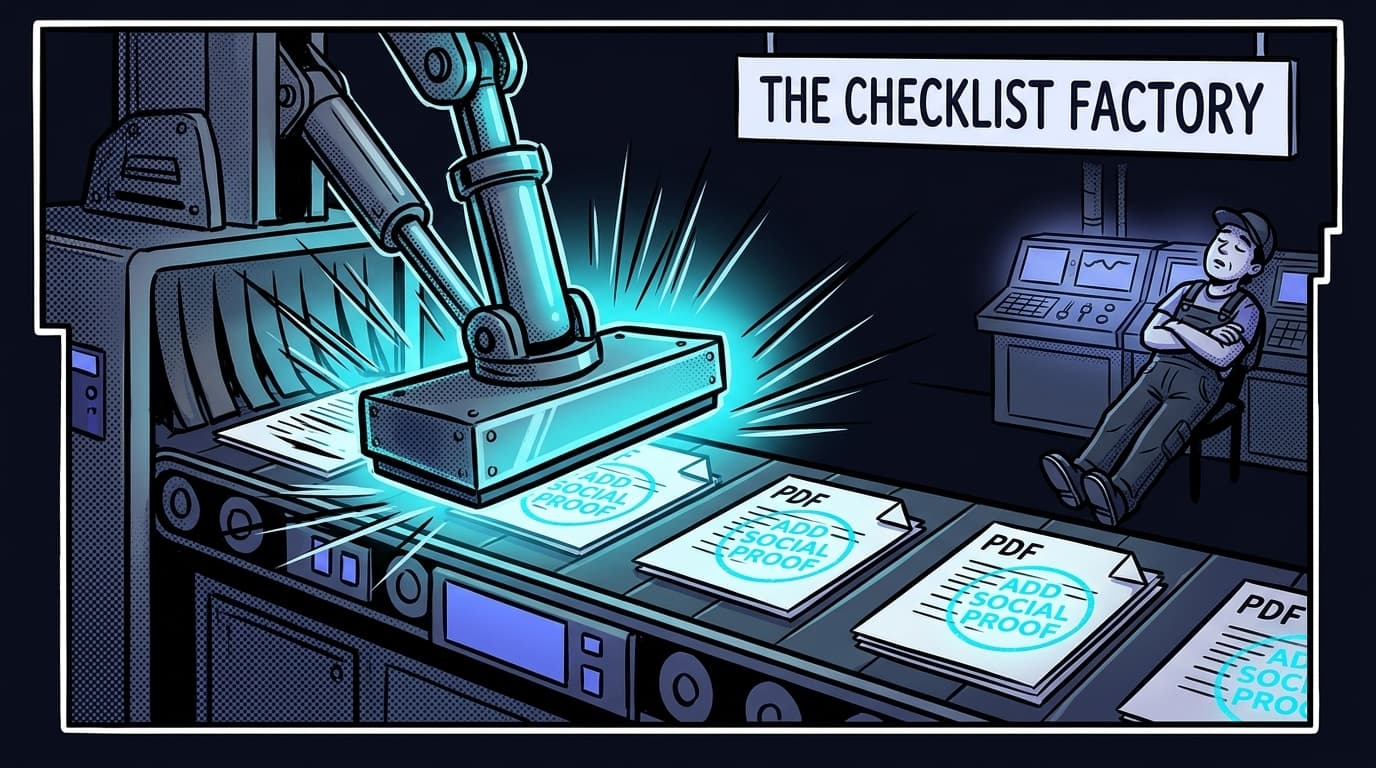
"Add social proof" addresses none of these specifically. It addresses all of them generically. Which means in practice it addresses none of them effectively. The client implements a logo strip. The price-sensitive buyer still leaves because pricing is missing. The skeptical researcher still leaves because logos are not third-party validation, they are advertising the brand chose to publish about itself. The technical evaluator still leaves because logos do not prove the product works. The recommendation looked correct. The result was nothing.
Peep Laja, founder of CXL and probably the most respected voice in CRO education, calls best-practice-driven audits "worthless". His argument: a hypothesis that is not grounded in an understanding of why the current page is failing produces tests that fail 80% of the time. The test is not the problem. The hypothesis quality is the bottleneck.
The data backs this up, and the data is brutal. Only 14 to 20% of A/B tests reach statistical significance. Failed experiments do not just fail to improve. They cause an average 26% decrease in conversion rate. 47% of CRO teams have no standard stopping point for tests, which means they run them long enough for noise to look like signal. Speero found that only 1 in 10 companies ever reach a mature experimentation program. The other 9 are stuck in what the industry quietly calls "random acts of testing". The audit produced the checklist. The checklist produced the tests. The tests failed. The cycle repeats. The client renews once. Maybe.
Only 14 to 20% of A/B tests win. When the other 80% lose, the problem is not the test. It is the hypothesis your audit handed them.
The framework problem
The output looks different because the screenshots are different. The methodology is identical, regardless of client.
Every audit installs the same tools. Every audit collects the same data types. Every audit analyses heatmaps, scroll depth, and session recordings. The framework does not change based on the client's product, vertical, visitor mix, or specific conversion problem. A B2B SaaS with a six-week sales cycle and a Shopify brand selling impulse-purchase candles receive structurally identical audits because the tools observe the same surface behaviours regardless of who is producing them.
This is not the agencies' fault. It is a tool limitation. Behavioural analytics can only show what happened. They cannot explain why. And without the why, every recommendation defaults to the same best-practice checklist. The difference between a default and a diagnosis is whether the recommendation is specific enough to the problem that implementing it will move the conversion rate. Defaults rarely do. Diagnoses usually do.
What 50 simulated visitors tell you that a heatmap cannot
Instead of "users do not click the CTA", a behavioural simulation tells you why three different visitor types each ignore it for three different reasons, with a quote from each.
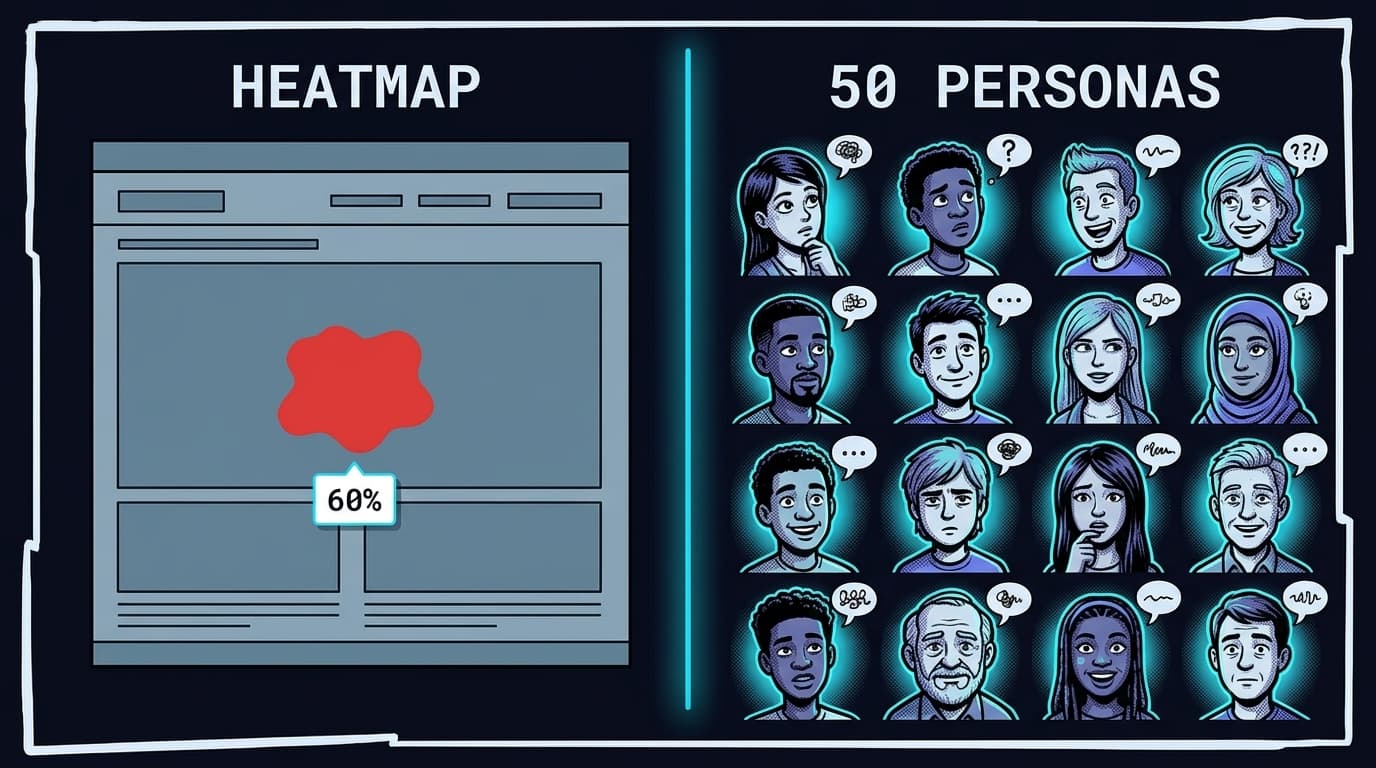
This is what WhyIQ does, and to be transparent up front: yes, this is our product. The methodology is what is actually interesting here. A scan runs 50 distinct visitor personas through the page in parallel. Each persona has defined goals, skepticism levels, technical knowledge, decision criteria, and emotional state, calibrated against more than 200 peer-reviewed papers on behavioural science, decision psychology, and trust formation. Each one reads your page, decides whether to engage, and reports why. The output is not "add social proof". The output is:
Key takeaway
"Price-sensitive visitors (8 of 50) skip the CTA because pricing is not visible above the fold. Skeptical researchers (6 of 50) ignore it because there is no third-party validation above it. Technical evaluators (5 of 50) read past it because the feature description is too vague to evaluate."
Same observed behaviour: low CTA click-through. Three different causes. Three different fixes. A traditional audit produces one recommendation. A simulation-based audit produces three, each targeted at a specific visitor segment, each addressing a specific motivational gap.
30-64%
conversion improvement from motivation-informed redesigns. Crazy Egg case studies
The case studies hold up. Crazy Egg saw 30% and then 64% conversion improvements from motivation-informed redesigns. 3M achieved roughly 50% improvement over twelve months after shifting from behavioural to motivation-based research. Companies using persona-based research are 33% more likely to improve lead quality. The method works. It just requires a different diagnostic layer than heatmaps alone can provide.
This is not a "replace your analytics stack" argument. Heatmaps still show you that 60% of visitors do not click the CTA, and that is genuinely useful. The simulation tells you which 60%, and why each segment skipped it. Heatmaps give you the observation. The simulation gives you the diagnosis. Together they produce hypotheses specific enough to have a meaningful win rate when tested. Separately, you have surveillance footage and a checklist.
The pillar your audit is probably ignoring entirely
There is a second hole in the standard CRO audit, and it is newer than the first. Your audit does not look at AI search.
Roughly 14% of B2B SaaS traffic that converts now arrives via AI search, and that share is growing fast (Exposure Ninja, 2026). ChatGPT, Perplexity, Claude, and Google AI Overviews are increasingly the first place your client's buyers go to compare options. The question is no longer just "does the page convert traffic" but "does the page get cited by AI engines, and is the snippet that gets cited the one that would actually convert a buyer". Most CRO audits do not score this at all. They are still living in the 2018 SEO model, where the only question is "do we rank in Google".
This matters for agencies specifically because the AI-search layer is where the easiest wins of 2026 live. The pages that are not getting cited are usually missing a small number of fixable signals: a brittle first paragraph that does not answer the buyer's question, schema gaps, weak third-party brand presence, and a stale modification date. Auditing this alongside CRO is a strict upgrade to the deliverable. The client sees you covering a surface their previous agency was not. The retainer renews.
WhyIQ scores AI Citability as a first-class pillar alongside CRO clarity. Eight dimensions, calibrated against a 482-run citation panel we published last week. The point is not that you have to use our tool to do this. The point is that the next generation of CRO audits has to include it, or it is selling a snapshot of a search landscape that no longer exists.
How agencies are turning this into a retainer (and a margin)
The agencies that add causality, simulation, and AI Citability to their audits charge more, deliver faster, and renew more clients. The ones that do not lose them to the ones that do.
The economics actually work in your favour here. A traditional audit takes two to four weeks of analyst time, billed at $3,000 to $5,000. A simulation-driven audit takes about fifteen minutes of compute time to produce the per-persona findings, the AI Citability score, and a prioritised fix list. The first time you run one, the rest of the cost is your interpretation layer, your strategic recommendations, your client-specific framing, and the client conversation that turns findings into action. That is exactly the work clients want to pay agencies for. The mechanical heatmap-screenshotting part is the part that was never the differentiator.
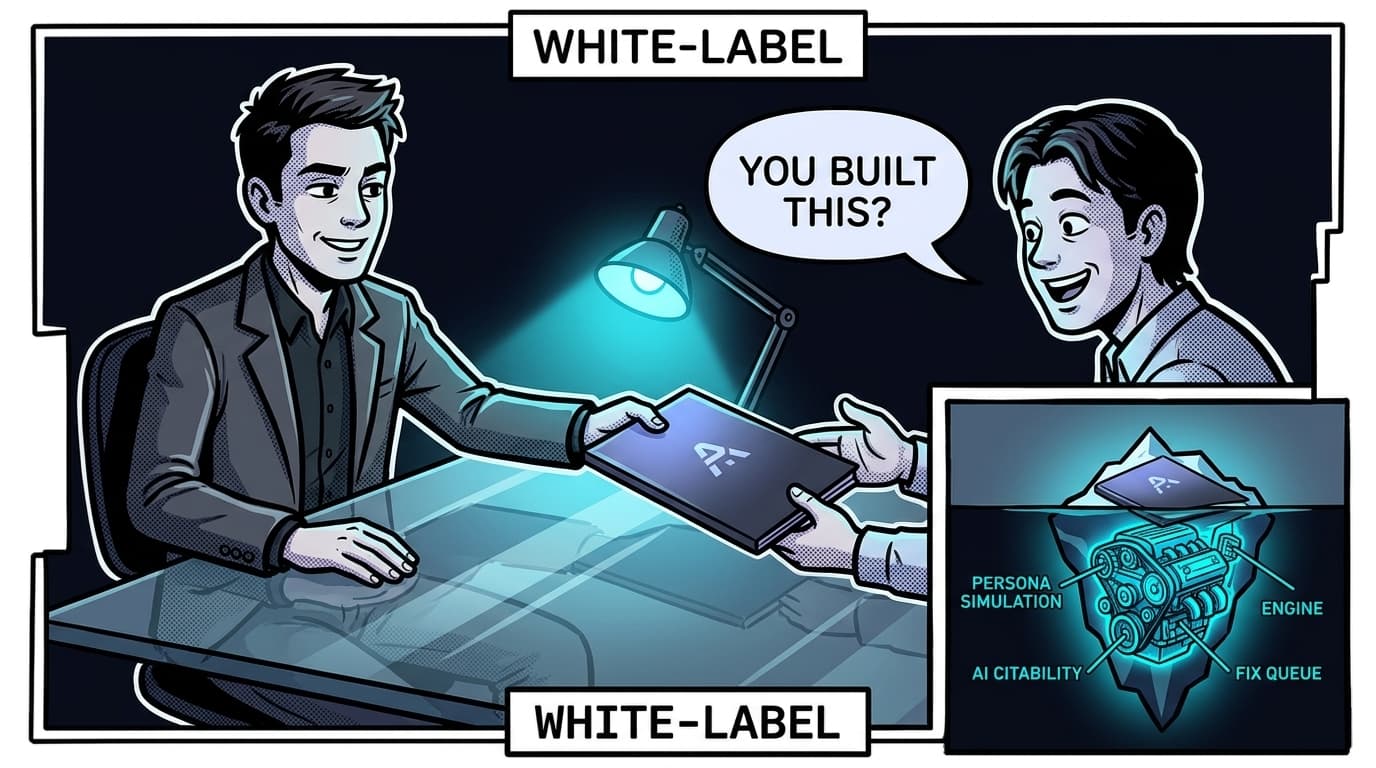
If you are running an agency, the path from "I read this blog post" to "I have a new product offer" is reasonably short. We built the white-label CRO audit specifically for this. The relevant bits, with no marketing wallpaper:
White-label reports. Your logo replaces ours. Your agency name appears in the headers and footers. The share link is on a neutral subdomain. The PDF cover is yours. The "Powered by WhyIQ" attribution comes off entirely. Clients see a deliverable that looks built from scratch in your shop.
Edit before share. The full report is editable before you send it. Add your commentary, remove the sections that do not apply to this client, adjust phrasing to match your firm's voice, swap in your own case studies. What lands in the client's inbox looks bespoke because, by the time you have edited it, it is.
Cross-client fix queue. Every recommendation across every client rolls up into a single prioritised feed. When you have 12 clients and 800 findings, the queue tells you what to action this week without forcing your team to read 12 PDFs in a row.
One scan covers a full site. A site scan crawls up to 25 pages on the Agency tier (10 on Pro, 5 on Starter). Each page gets its own deep-dive plus a combined site report. About 10 to 15 minutes per site. For comparison: that is the same workflow that took two to four weeks manually before the engine existed.
A site scan on the Agency plan costs you 3 credits out of 150 a month. Run cross-client audits weekly without thinking about pricing per scan. The math on a $249 a month plan that lets you ship 50 white-label site audits is not subtle. We are not the only tool that does this, but we are the only one that does it with persona-level causal attribution and AI Citability scoring built in.
The threat is real even if you decide not to change anything. If 80% of audit-derived tests fail, the audit methodology has a structural hypothesis-quality problem that clients will eventually notice. Agencies that keep producing behavioural observations without motivational analysis or AI Citability will watch their renewal rates stagnate while competitors who have added the missing layers produce better results at the same price point. The tools exist to add this now. Understanding why visitors leave is not a months-long qualitative research project anymore. It is a fifteen-minute scan and a strategy conversation.
Frequently asked questions
Why do most CRO audits fail to move the conversion rate?
Most CRO audits produce recommendations from behavioural data: where users click, how far they scroll, which elements they interact with. This shows what happened, not why. Without understanding visitor motivation, recommendations default to generic best practices that apply to any page, for any product, with any visitor mix. Only 14 to 20% of A/B tests derived from traditional audits reach statistical significance, and failed experiments cause an average 26% decrease in conversion rate. The bottleneck is the hypothesis quality, not the testing methodology.
What is wrong with heatmap-based CRO?
Heatmaps cannot distinguish confusion from engagement. A cluster of clicks tells you visitors interacted with an element, not whether they were confused, interested, or frustrated. Optimizely's own documentation calls heatmap insights 'usually obvious and non-actionable'. Scroll maps can be actively misleading because they show where visitors stopped, not why. Mouse position does not equal visual attention. And heatmaps aggregate every visitor into one view, erasing the differences between visitor types that are usually the actual story.
What should a 2026 CRO audit actually include?
Three layers, not one. Behavioural data (what happened): heatmaps, scroll depth, session recordings, funnel analytics. Motivational analysis (why it happened): persona-based simulation, user interviews, or survey data, producing segment-specific diagnoses rather than generic best practices. And AI Citability scoring: whether the page is being cited correctly by ChatGPT, Perplexity, Claude, and Google AI Overviews, which is increasingly the first place your client's buyers compare options. An audit missing any of these layers is selling a 2018 snapshot in a 2026 market.
How is WhyIQ different from Hotjar or VWO?
Hotjar and VWO are excellent behavioural-observation tools. They show what visitors did with high precision. WhyIQ adds the motivational layer they cannot. Fifty simulated visitor personas run through the page in parallel, each with defined goals, skepticism levels, and decision criteria, and each reports back not just where they bounced but why. WhyIQ also scores AI Citability across eight dimensions in the same scan. Used together, you get the observation (heatmap), the diagnosis (simulation), and the AI search layer (citability) in one workflow. They are complementary tools, not competing ones.
Can WhyIQ produce a white-label CRO audit my agency can resell?
Yes. The Agency plan replaces our logo with yours, removes the 'Powered by WhyIQ' attribution entirely, and serves reports on a neutral share link. You can edit the report before sending, add your own commentary, remove sections, and adjust the language to your firm's voice. PDF exports and shareable links both carry your branding. Clients see a deliverable that looks built from scratch in your shop. A site scan covers up to 25 pages and takes about 10 to 15 minutes.
How long does a WhyIQ audit take compared to a manual one?
A single page scan finishes in about two minutes. A multi-page site scan covers up to 25 pages on the Agency plan in about 10 to 15 minutes total. The traditional manual-audit workflow takes two to four weeks of analyst time. The full comparison, including methodology differences and what a manual analyst still adds on top, is in our WhyIQ vs manual audit page.
What is a causality-based CRO audit?
A causality-based audit answers why visitors behave the way they do, not just what they do. Instead of 'users do not click the CTA', it produces segment-specific diagnoses: 'price-sensitive visitors skip the CTA because pricing is missing; skeptical visitors skip it because there is no third-party validation above it; technical visitors skip it because the feature description is too vague to evaluate'. Different fixes for different visitor types. Hypotheses that win tests instead of failing 80% of them.
Does adding AI Citability scoring to a CRO audit actually matter for clients?
It is increasingly the highest-leverage layer to add. Roughly 14% of B2B SaaS converting traffic now comes via AI search, and that share is growing. ChatGPT, Perplexity, Claude, and Google AI Overviews are often the first place buyers compare options. Most CRO audits do not score this at all. The pages that are not getting cited are usually missing a small number of fixable signals: a weak first paragraph, schema gaps, weak third-party brand presence. Auditing this alongside CRO is a strict upgrade to the deliverable.
Go deeper
For the AI search layer, see Why ChatGPT Cites Some Sources and Ignores Others: 482 AI search queries, the 0.6% non-brand citation rate, and the five moves that close the gap.
Why every audit ends with "add social proof"