Someone is selling you an answer to this question, and which answer you get depends on what they sell. The agency pivoting to "GEO services" says SEO is dead. The agency that still bills for backlinks says AEO is a fad. Both are talking their book.
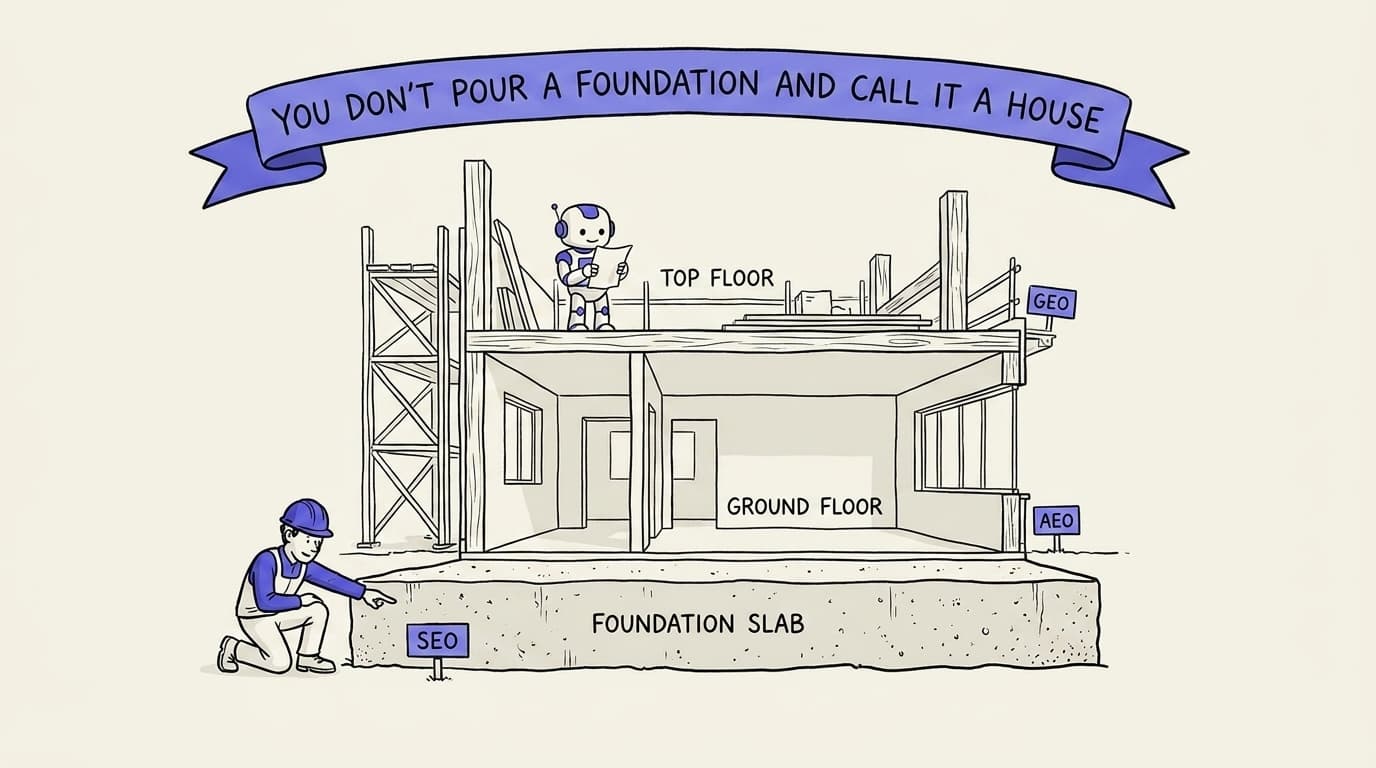
Here is the answer the 2026 data actually supports: no, AEO and GEO do not replace SEO. They are a new layer that sits on top of it. Answer engine optimization (AEO) is about being the answer an AI assistant gives. Generative engine optimization (GEO) is about being the source it cites. Both still depend on the same crawlable, fast, server-rendered foundation that traditional SEO has always built. The brands winning AI search are, overwhelmingly, the brands that already rank organically.
What changed is not whether SEO matters. It is the lever that moves results above the foundation. For two decades that lever was backlinks. In AI search it is brand mentions: who talks about you, by name, on the sites these engines trust. ChatGPT has 900 million weekly users now (OpenAI, February 2026), and AI Overviews are quietly eating the organic clicks SEO used to deliver. Ignoring this layer is the actual risk. Treating it as a replacement for the foundation is the other mistake. This post covers both.
We will define the three terms, answer "is SEO dead" head on, show what is shared versus what diverged, work out whether you actually need to do AEO yet, and finish with the concrete moves that get a page cited. Every number below is sourced. Where our own earlier figures drifted out of date, we corrected them.
Answer Engine Optimization vs Generative Engine Optimization (vs SEO)
Three acronyms, three different jobs, one shared foundation.
SEO is optimizing to rank in a list of blue links on Google. The unit of success is a position. AEO, answer engine optimization, is optimizing to be the answer itself: the snippet, the AI Overview, the spoken reply. The unit of success is being the response, not a link next to it. GEO, generative engine optimization, is the academic term for the same shift, with the emphasis on being the source a generative model cites when it composes an answer. In practice AEO and GEO are used interchangeably; treat them as one discipline aimed at AI answers, and SEO as the discipline aimed at ranked results.
They are not synonyms and they are not rivals. They are layers. A useful way to hold it: SEO earns the position, AEO earns the answer, GEO earns the citation. The reason they feel like the same thing is that they share most of their plumbing. A page that an AI engine cannot crawl, cannot parse, or considers stale will not be cited no matter how good the copy is, which is exactly the condition traditional SEO already solved for. The divergence shows up one level up, in what decides who wins among the pages that clear that bar.
Key takeaway
SEO ranks, AEO answers, GEO gets cited. They are layers on one stack, not competitors. Most of the technical work is shared; the part that is genuinely new lives at the top.
Is SEO Dead?
No. But the "SEO is dead" crowd is pointing at something real, so it is worth being honest about what is actually dying.
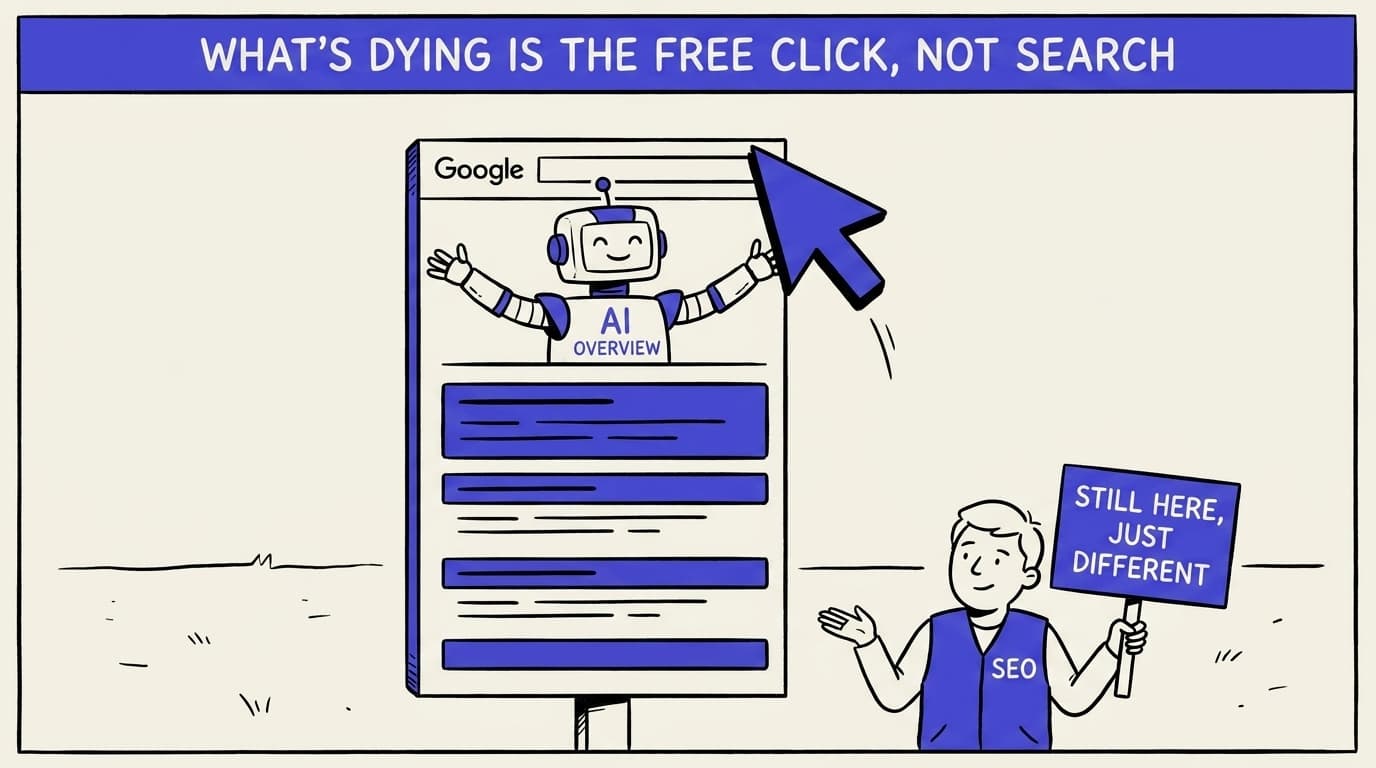
What is dying is the free organic click. When Google answers a query with an AI Overview, the user often never clicks through. Ahrefs measured a 58% drop in click-through rate for the number-one organic result when an AI Overview appears (Ahrefs, 2025). A separate field study found AI Overviews cut organic clicks by 38% on the queries that trigger them, with zero-click searches rising from 54% to 72% (Search Engine Journal, 2025). The median publisher lost about 10% of organic traffic year over year in the first half of 2025. If your entire strategy was "rank number one and collect the clicks", that strategy is genuinely eroding.
What is not dying is search demand or the value of ranking. People are searching more, not less, they are just doing some of it inside ChatGPT and Perplexity. And ranking still feeds the AI layer: the pages search engines rank are the raw material AI answers are built from. "SEO is dead" is a headline. "The free organic click is shrinking, so ranking now has to earn you a citation as well as a position" is the accurate, less clickable version.
58%
drop in click-through rate for the #1 organic result when an AI Overview appears. Zero-click searches rose to 72% on triggered queries. Ahrefs, 2025; Search Engine Journal field study, 2025
Does AEO/GEO Replace SEO, or Do They Work Together?
They work together, and the dependency only runs one way: AEO needs SEO. SEO does not need AEO to function, but it is now incomplete without it.
Start with the hard constraint. Before any AI engine can cite your page, it has to read your page, and most of them read it the way a 1998 browser would. The major AI crawlers, GPTBot, ClaudeBot, and PerplexityBot, do not execute JavaScript. Vercel and Merj analyzed more than 500 million GPTBot fetches and found zero evidence of JavaScript rendering. Only Google's crawler, the one feeding Gemini and AI Overviews, runs JS. So if your pricing, your headline, or your proof renders client-side, most AI engines see a blank page. That is a server-rendered-HTML problem, which is to say a traditional SEO problem.
Then look at where AI answers source from. Google's own June 2026 guidance says its AI features are rooted in its core Search ranking systems, so optimizing for them is still SEO. ChatGPT can only cite pages its crawler, OAI-SearchBot, is allowed to fetch, and it retrieves through several search sources rather than Bing alone, which makes being crawlable the first requirement there too. Ranking is not a separate game from getting cited; it is the foundation of it. You cannot skip the foundation and win the top floor. The companies that try to "do GEO" without crawlable pages, internal linking, and freshness are pouring effort into a layer that has nothing under it.
AEO without SEO is a house with no foundation. The first AI model update knocks it down.
Key takeaway
The dependency runs one way. AI engines require a crawlable, server-rendered, fresh page (an SEO outcome) before they can cite it, and they draw heavily on ranked results. Do AEO on top of SEO, never instead of it.
Do I Actually Need to Do AEO?
Probably yes, but for a sharper reason than "AI is the future". The reason is conversion quality, not volume.
Be honest about volume first: AI referral traffic is still small. It is roughly 1% of total sessions for most sites today. If you only count visits, AEO looks like a rounding error and it is tempting to wait. The volume case is weak, and anyone telling you AI traffic already dwarfs Google is selling something.
The conversion case is the strong one. An analysis of 12 million website visits found AI-referred visitors converted at 14.2%, against 2.8% for Google organic, roughly a 5x gap (Opollo and RankScience, 2026). Ahrefs found AI accounted for 0.5% of sessions but 12.1% of signups. The mechanism is obvious once you see it: someone who lands on you because ChatGPT recommended you by name has already had the comparison done for them. They arrive pre-qualified. So the question is not "is AI traffic big yet". It is "can I afford to be invisible in the channel that sends the highest-intent visitors I will get all year, while it is still cheap to win". For most B2B and considered-purchase businesses, the answer is no. If you sell impulse products to people who will never ask an AI for a recommendation, you can wait.
14.2% vs 2.8%
conversion rate for AI-referred visitors versus Google organic, across 12 million visits. Roughly a 5x gap. Opollo and RankScience, 2026
What Changed: Backlinks Gave Way to Brand Mentions
This is the one genuinely new thing, and it is the thing most "AI SEO" advice gets wrong. The authority signal changed substrate.
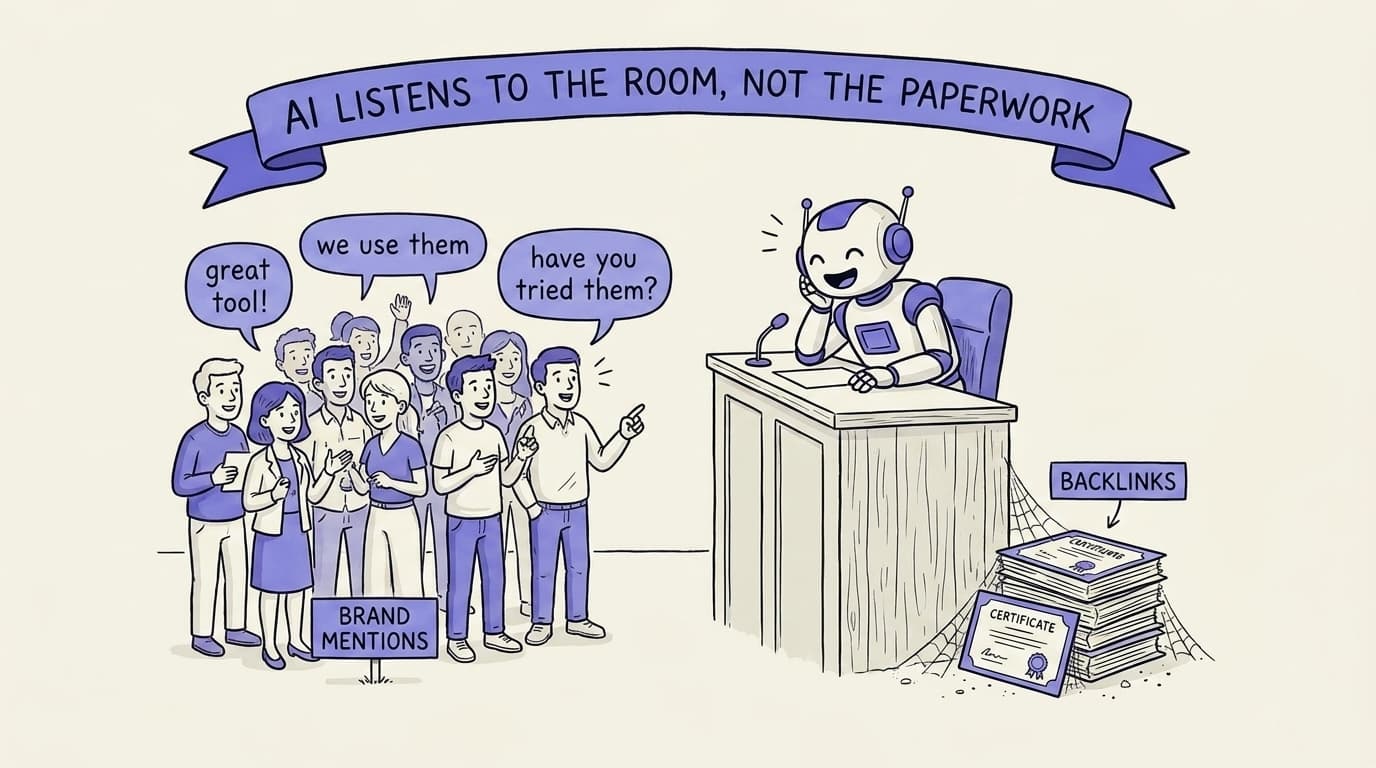
For twenty years authority meant backlinks: who formally linked to you. AI engines learned authority somewhere else, from the open web of text where brands get named in context by other people, link or no link. Across multiple 2025 studies the pattern is consistent. Unlinked brand mentions correlate with AI citation at roughly r=0.664, while backlinks come in at about r=0.218, a three-to-one gap. Ahrefs, looking across 75,000 brands, found brand mentions outweigh backlinks for AI Overview presence at about 3:1 (May 2025), and its December 2025 follow-up found brand mentions correlate with visibility at 0.66 to 0.71 across ChatGPT, AI Mode and AI Overviews, with YouTube mentions the strongest single correlate. Muck Rack found 82% of AI-cited links come from earned media, not owned content.
The mechanism is mechanical, not mystical. A backlink is one site formally voting for another, usually in a footer or a resource page. A brand mention is the wider conversation already including you, casually, mid-sentence, on a forum or a review or a roundup. Language models trained on that conversation. They learned to trust the names that come up when humans discuss a topic, not the names in a link graph. Backlinks were a vote. Brand mentions are the conversation, and AI search learned from the conversation.
3x
Unlinked brand mentions correlate with AI citation about three times more strongly than backlinks (r=0.664 vs r=0.218). 82% of AI-cited links come from earned media. Soar/Wellows 2025; Ahrefs (75K brands); Muck Rack, 2025
Where SEO and AEO Diverge Most: the Retrieval Substrate
"Optimize for AI" is a meaningless instruction until you name the AI. The engines do not agree with each other, and they are not trying to.
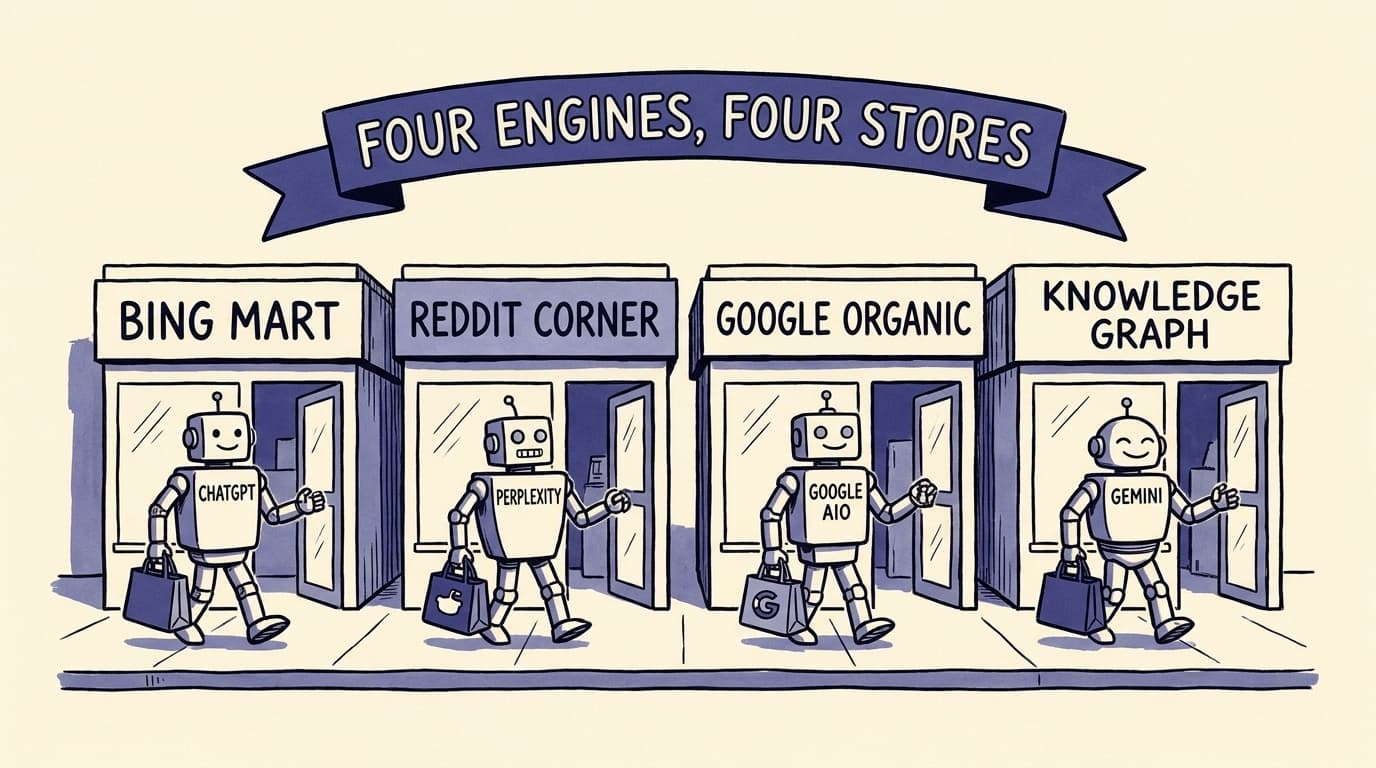
Each engine pulls from a different place. ChatGPT can only cite pages its crawler, OAI-SearchBot, is allowed to fetch, and it retrieves through several search sources rather than Bing alone. Perplexity leans heavily on community content, and Reddit is its single most-cited domain. Google AI Overviews draw on Google's core ranking systems plus the Knowledge Graph and structured data. Gemini grounds in Google Search and leans toward listicles. The overlap between them is tiny: only 11% of cited domains appear in both ChatGPT and Perplexity answers (The Digital Bloom, December 2025). Win one engine and you have likely done almost nothing for another.
The substrate also moves. Reddit's dominance is already slipping; YouTube overtook it as the most-cited source in early 2026, and after Reddit sued Perplexity in late 2025, Perplexity's Reddit citations fell about 86% almost overnight, with YouTube filling the gap. Review platforms are the steadier bet: Semrush's November 2025 cross-platform study put G2 in the top 20 most-cited domains overall, the only B2B review site to make the list. The lesson is not "go all in on Reddit". It is that AEO is a presence-everywhere game on substrates you do not control, and the mix shifts under you. SEO, by contrast, optimizes for one substrate, Google, that changes slowly. That difference in volatility is the real day-to-day divergence between the two disciplines.
How Do I Do AEO? How Do I Get Cited in AI Answers?
Five moves, ordered by evidence. The first three live on other people's domains. The last two live on yours.
1. Claim and fill your review-site listings. G2, Capterra, TrustRadius, AlternativeTo, GetApp. These are weighted across every engine, and G2 is one of the most-cited domains on the entire web for software queries. One study found review-platform presence alone lifts cited rate from 1.8% to 4.6-6.3%, regardless of how big your domain is (SE Ranking, 2025). It is the highest-leverage move and the one teams skip because it feels like admin.
2. Show up in the communities your buyers trust. Reddit, YouTube, niche forums, Quora. Not as link-drop spam, as genuine, named contributions. Third-party formats dominate: the top three citation formats (blog posts, listicles, comparison pages) account for 66.9% of all AI citations, and third-party listicles were 80.9% of citations in professional services (Goodie, 2025). Getting included in a "best tools for X" roundup does more for your AI visibility than your own homepage.
3. Earn third-party listicle inclusion. The "Top 10 X" format you thought was dead SEO bait is a primary AI citation source. A 100-word pitch to the author, with one statistic about your product and one about a category competitor, does the writer's research for them. It works.
4. Put the answer in your first paragraph. 44.2% of AI citations come from the first 30% of a page (Search Engine Land, 2025); models extract sentences, not whole pages, and they read top-down. Lead with a specific, sourced claim: a number, an attribution, a named concept. The content moves that lift citation are measurable: adding statistics lifts citation by 22%, adding quotations by 37%, citing sources by 115% (Princeton GEO study, 2024).
5. Refresh on a calendar. AI citations decay fast. The median citation half-life is about 4.5 weeks (Scrunch and Stacker, 3.5 million citation events), roughly half of all AI-cited content is under 13 weeks old, and pages updated within 30 days earn around 3.2x more citations. Pick your 8-12 most important pages and refresh them quarterly, with a visible "last updated" date. And do not bother with llms.txt: three studies across 300,000+ pages found no measurable effect, and Google has said it has no plans to support it.
44.2%
of AI citations come from the first 30% of a page. The lede is no longer a stylistic choice, it is the citation surface. Search Engine Land study, 2025
Should You Do SEO and AEO at the Same Time?
Yes, because they are mostly the same work, run once. The trap is treating them as two budgets.
Map your effort to the stack. The foundation, crawlable server-rendered HTML, fast pages, clean heading structure, internal links, regular freshness, is one body of work that pays off in both ranked results and AI citations. You do not do it twice. On top of that foundation, the AEO-specific work is narrow and additive: earn the brand mentions, lead every page with a sourced answer, keep the refresh calendar. That is the moat layer. It does not replace the foundation work, it compounds with it, because a page that ranks well is also a page AI engines are more likely to reach and trust.
The honest operating model for 2026 is not "SEO or AEO". It is one stack: technical foundation at the bottom, on-page answer quality in the middle, off-site brand presence at the top, measured at both ends. Measure readiness, whether your page carries the signals AI engines reward, and measure reality, whether engines actually cite you. The first tells you if you built the moat. The second tells you if it is holding.
That split between readiness and reality is exactly how we think about it. The on-page side, the signals each engine rewards, is what our answer engine optimization framework and the AI Citability Playbook cover in depth. The reality side, whether ChatGPT, Perplexity, Claude, Gemini, and Google AI actually name you on the queries that matter, is what WhyIQ AI Radar tracks weekly. We ran our own non-brand citation panel and found a 0.6% cited rate across 482 queries, which is the gap this whole post is about. Most domains have not built the moat yet. That is the opportunity.
Frequently asked questions
Is SEO dead?
No. SEO is being reshaped, not killed. Traditional organic clicks are shrinking as AI Overviews answer more queries on the results page (Ahrefs found a 58% click drop for position one in 2025), but search itself is growing. The brands that win AI citation are almost always the ones that already rank organically.
Is AEO different from SEO?
Yes, but they overlap heavily. SEO is about ranking on Google. AEO (answer engine optimization) is about being the answer an AI engine gives. They share a foundation: crawlability, server-rendered HTML, freshness, clean headings. They diverge on the authority signal (brand mentions over backlinks) and on which retrieval substrate each AI engine pulls from.
Does AEO/GEO replace SEO?
No. AEO and GEO are a layer on top of SEO, not a replacement for it. AI engines need a crawlable, server-rendered, fresh page before they can cite it, and ranking signals still feed AI answers (Google says its AI features are rooted in its core Search ranking systems). Doing AEO without the SEO foundation does not work.
Do I need to do AEO?
If your buyers use AI search, yes. ChatGPT alone has 900 million weekly users (OpenAI, February 2026) and roughly a third of consumers now start with an AI tool. AI referral traffic is still small, around 1% of sessions, but it converts about 4-5x higher than organic (14.2% versus 2.8% in one 12-million-visit study).
Should I do both SEO and AEO?
Yes, as one stack. The technical foundation (crawlability, server-rendered HTML, freshness, structure) serves both at once. The AEO-specific work is the brand-mention moat layered on top: review-site listings, community presence, third-party listicles. You generally cannot earn AI citations without the SEO foundation underneath.
How do I do AEO?
Earn third-party brand mentions (review sites, Reddit, YouTube, listicles), put a specific sourced answer in the first 30% of each page, keep crawlable server-rendered HTML, and refresh top pages on a calendar. Skip llms.txt, which three studies across 300,000+ pages found has no measurable effect on citation.
How do I get cited in AI answers like ChatGPT and Perplexity?
Be mentioned by name in the third-party content each engine trusts. ChatGPT can only cite pages its crawler, OAI-SearchBot, may fetch; Perplexity leans on community sources like Reddit and YouTube; review platforms like G2 are weighted across all of them. On-page, lead with a quotable, sourced statistic: 44.2% of AI citations come from the first 30% of a page.
Does schema markup or llms.txt help AI citation?
Schema helps Google AI Overviews, which inherits Google's structured-data pipeline, but it is largely invisible to ChatGPT, Perplexity, and Claude when they fetch your HTML directly. llms.txt shows no measurable effect: only about 10% of sites have one, the crawlers rarely read it, and Google has said it has no plans to support it.
Go deeper
For the full implementation, see the AI Citability Playbook: the 8 signals AI engines weigh, the platform differences across ChatGPT, Perplexity, Claude, and Google AI Overviews, and a 5-move 90-day plan. The data behind the brand-mention finding is in why ChatGPT cites some sources, and the crawler-readability floor is in why 69% of AI crawlers cannot read your site.