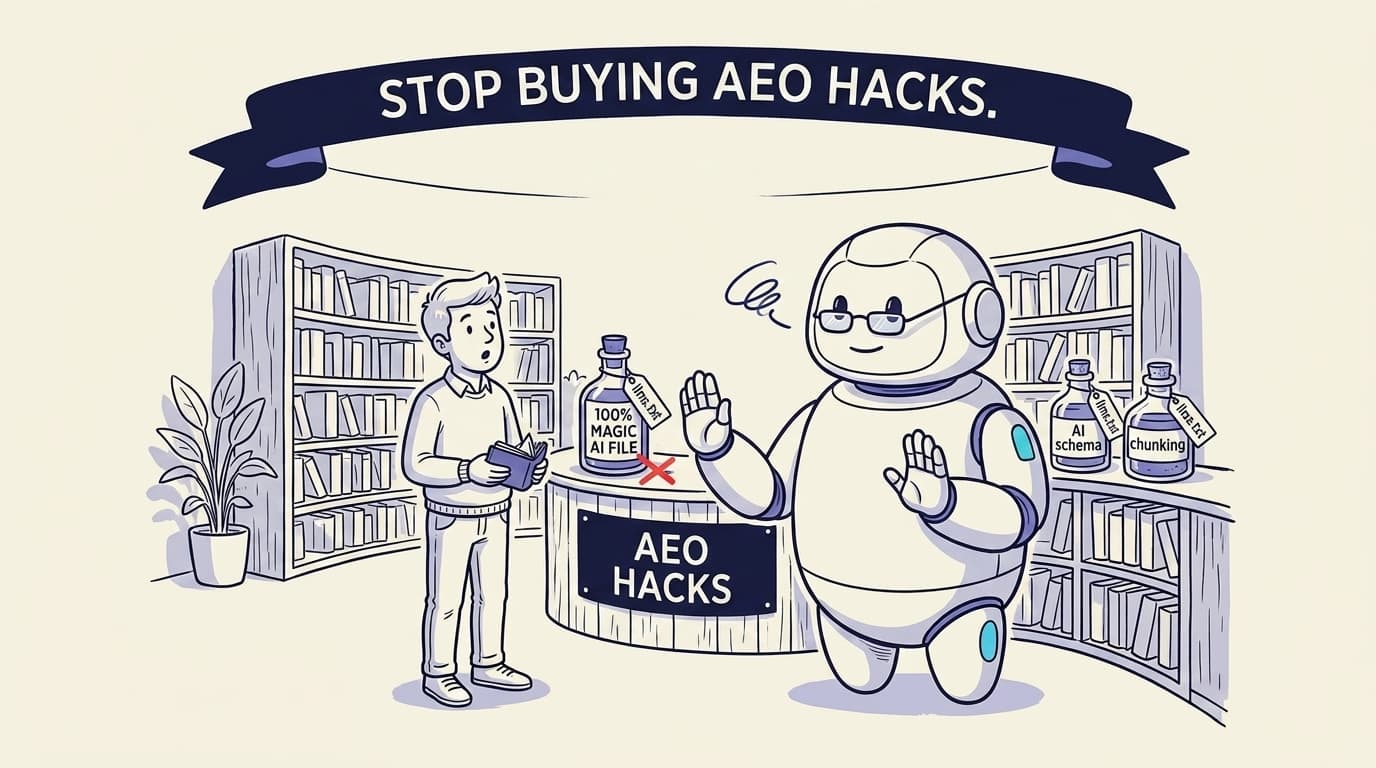
For two years, a small industry has been selling you AEO hacks. The magic file. The schema voodoo. The "chunk your content for the robots" course. Google just put the official version of an inconvenient truth in writing: most of it does nothing. Its June 2026 guide says it flat out. llms.txt? "Google Search ignores them." Chunking your pages into bite-size fragments? Not needed. Rewriting everything for the machines? Wasted effort. Optimizing for AI search, Google says, is just optimizing for search, and that is still SEO. Roughly 76 percent of the URLs cited in AI Overviews already rank in Google's top 10 (Semrush, 2026). So no, AEO did not kill SEO. But here is the part nobody selling you a course will mention: Google's "you don't need to" list is scoped to Google's own engine.
The guide is "Optimizing your website for generative AI features on Google Search," last updated June 15, 2026. It is unusually blunt for a search company, and I read the whole thing so you can have it in five minutes. Here are the five things it tells you to stop doing, the one bar it tells you to clear, and the catch that decides whether you follow its advice everywhere or just on Google.
What Google Actually Said
For the first time, Google wrote its AI-search advice down. The headline: there is no separate game to play.
AI Overviews and AI Mode sit on top of the core Search ranking systems. They work by grounding (retrieving live, ranked pages and reading them) and by query fan-out (turning one question into several). If you want that machinery taken apart bolt by bolt, I did it in how AI search decides what to cite. The thesis here is shorter: optimizing for generative AI search is still SEO. No secret AI index. No magic file. The page that gets cited is the page that was retrievable, relevant, and worth quoting the moment the engine ran the query. Being cited is mostly the work of being findable, and that is the work you already knew how to do.
The 5 Things Google Says You Can Stop Doing
This is the list the hack-sellers do not want you reading. Here it is, in Google's own words.
- llms.txt and special AI markup. "Google Search ignores them." Building one for other services is harmless, just not a Google lever.
- Chunking your content. Not needed. There is "no ideal page length," and Google's systems "understand the nuance of multiple topics on a page."
- Rewriting content just for AI. Not needed. "AI systems can understand synonyms and general meanings."
- Chasing inauthentic mentions. Seeking them "isn't as helpful as it might seem."
- Overfocusing on structured data. Not required for generative AI features. It is still valuable for rich-results eligibility, just not the AI lever.
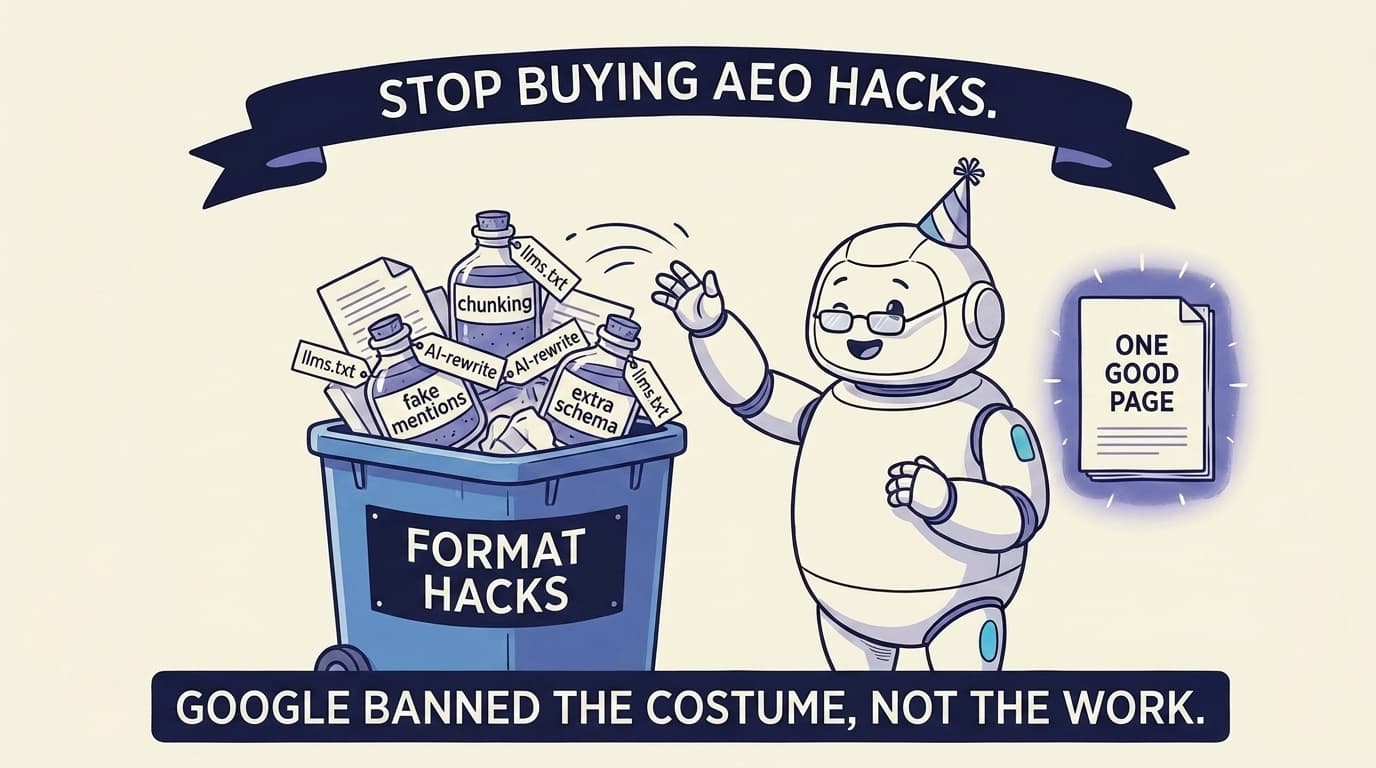
Notice the through-line. Every item on that list is a format hack, a way of dressing your page up for a machine. Google's whole point is that the machine does not want the costume. It wants the page underneath.
0
special AI files Google Search reads. llms.txt and AI-only markup are ignored. Google Search Central, generative AI features guide, 2026
Key takeaway
Every item on Google's "don't bother" list is a formatting trick. None of them touch whether your page is worth quoting. That is the tell: Google is not banning effort, it is banning costumes.
Google did not ban the work. It banned the costume. The page still has to be worth quoting.
The One Bar Google Tells You to Clear
Google took away the hacks and left one standard in their place. It is harder to fake than any markup, and that is the point.
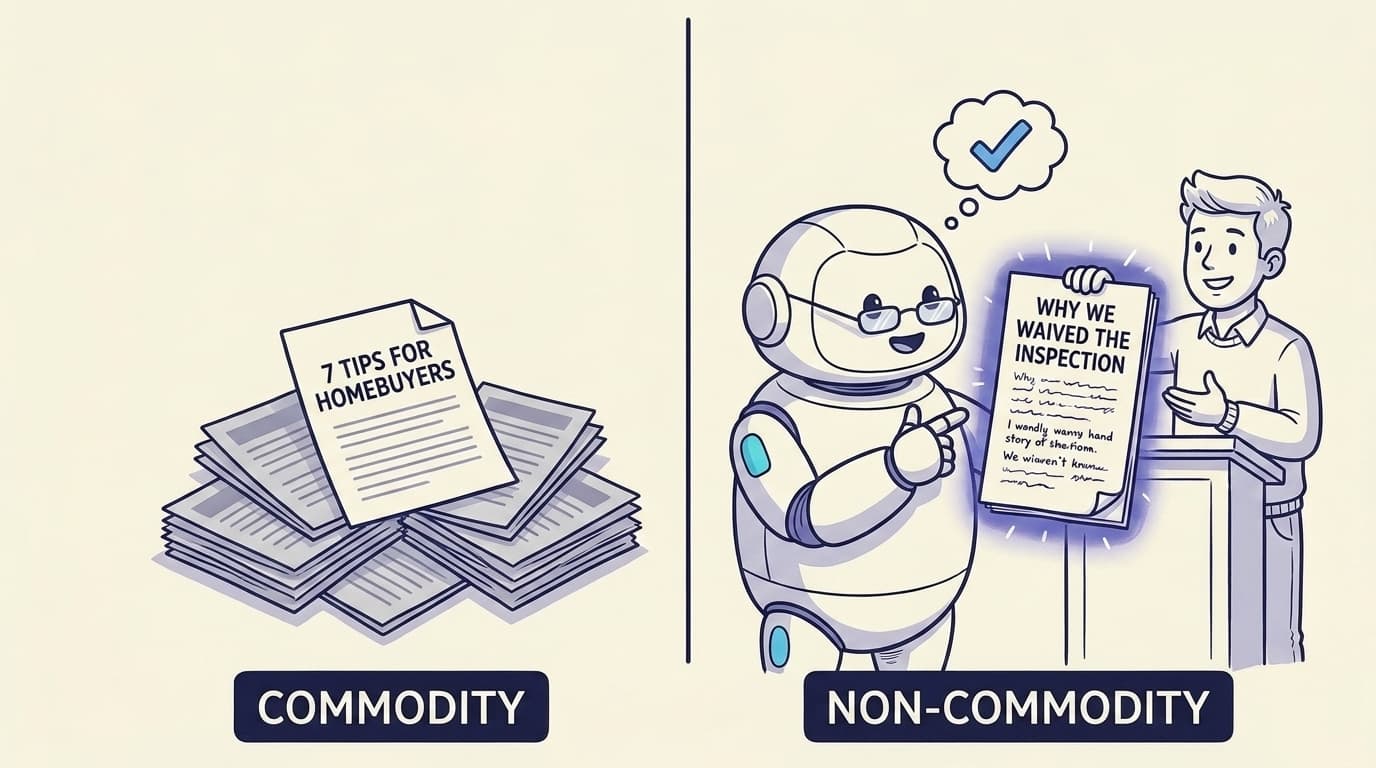
The bar is content that is non-commodity, first-hand, expert-led, and people-first. Google's own example does the work: the commodity post "7 Tips for First-Time Homebuyers" loses to "Why We Waived the Inspection and Saved Money: A Look Inside the Sewer Line." One you could generate in your sleep. The other you had to live. And the answer to query fan-out is not more thin pages, it is fewer better ones. Spinning up a near-duplicate page for every query variation is scaled content abuse, a named spam violation, not a growth tactic. One page with real substance beats fifty with none.
~40%
lift in generative-engine visibility from adding real statistics, citations, and quotes. Keyword stuffing did nothing. Princeton GEO, Aggarwal et al., KDD 2024
Key takeaway
The bar is substance, not format. Real experience, real evidence, real expertise. It is harder than buying a markup file, which is exactly why it works.
Here's the Catch Google Won't Tell You
Every "you don't need to" on that list comes with an asterisk Google does not print: scoped to Google's engine. Several of them still matter everywhere else.
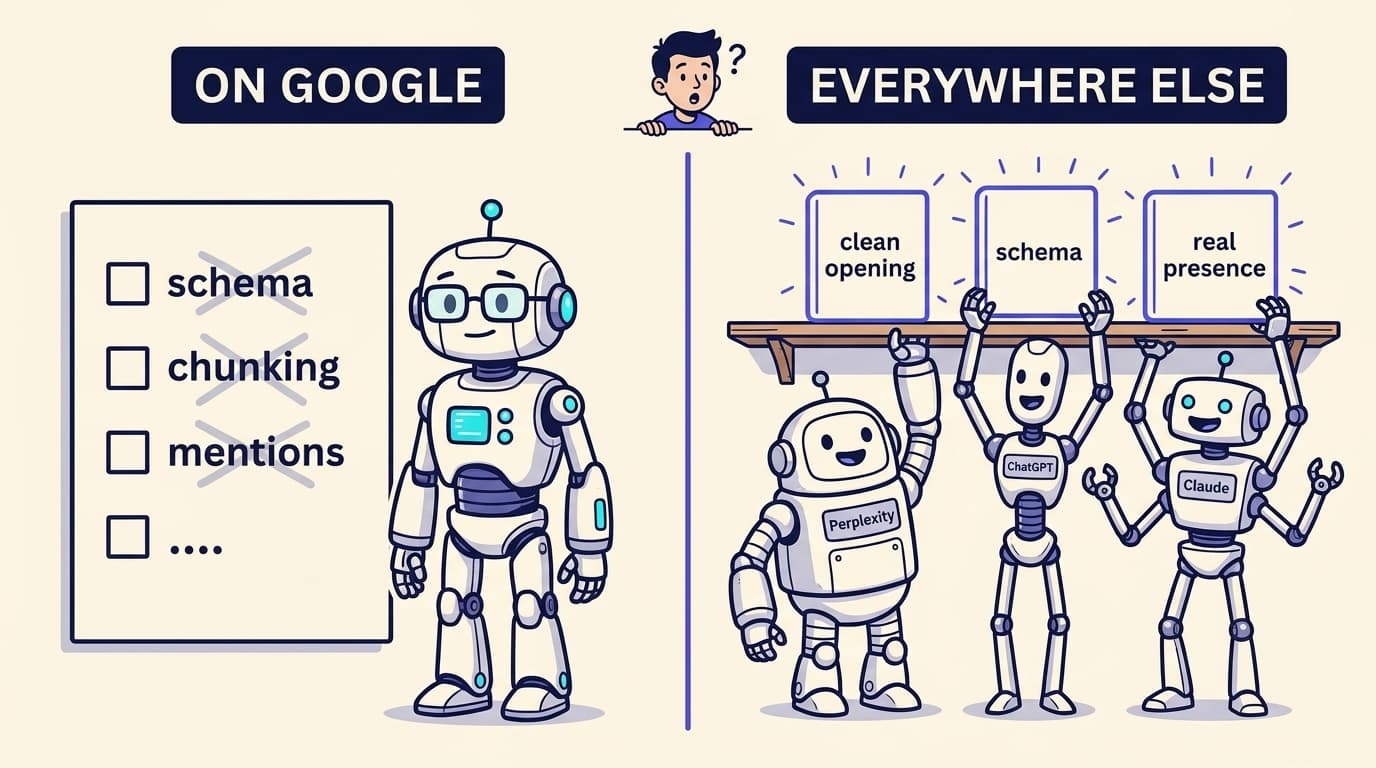
Google is one engine. Three items on its "skip it" list flip the moment you leave. Structured data barely moves Google AI citation, but it helps rich results and moderately helps ChatGPT and Claude. A clean, self-contained opening paragraph is the "chunking" Google says it does not need, because it handles passages itself, and yet Perplexity-style retrieval rewards exactly that. And authentic third-party presence is not the inauthentic mention-spam Google warns against. Real presence, the kind you cannot buy, is the single biggest citation source across engines.
10.15%
of all AI citations are brand-owned. The rest go to third parties: Reddit 20.8%, YouTube 13%, LinkedIn 11%, G2 4%. Foundation + AirOps, 57.2M-citation study, 2026
So here is the resolution the whole thing builds to. Google's myth-busts are about format hacks, and you should drop them. The cross-engine evidence is about substance plus real distribution, and those pay. It looks like a contradiction only until you separate formatting for the machine from evidence and presence for the reader. Do that, and both are true at the same time. Google is not wrong. It is just talking about Google.
This is why WhyIQ does two different jobs. WhyIQ AI Radar runs your real buyer queries through five real engines every week, including Google's AI Mode, and reads back the URLs each one actually cited, so it measures citation the same retrieve-and-cite way the engines produce it. The page scan reads your page the way an AI browser agent does, by screenshot, DOM, and accessibility tree, and predicts how ready it is. The Index predicts; Radar measures.
Key takeaway
Google's "don't bother" list is real, on Google. Off Google, schema, a clean quotable opening, and authentic third-party presence still earn citations. The hacks die; substance and real distribution do not.
Frequently asked questions
Did Google say AEO is dead or that you should stop doing it?
No. Google's June 2026 guide says optimizing for AI search is still SEO, not a separate discipline. It tells you to stop doing specific format hacks like llms.txt and chunking, not to stop optimizing. About 76 percent of AI Overview citations already rank in Google's top 10 (Semrush, 2026).
Does llms.txt actually do anything?
Not for Google. Google's official guidance states Google Search ignores llms.txt and special AI markup. Building one for other tools or services is harmless, but it is a hygiene file, not a citation lever. No independent study has found a measurable Google citation lift from publishing one.
Do I need structured data to get cited by AI?
Not on Google. Google says structured data is not required for its generative AI features. It still matters for rich-results eligibility, and it helps moderately on ChatGPT and Claude. Treat schema as a rich-results and cross-engine signal, not a Google AI citation lever. Useful, just not the lever it is sold as.
What is non-commodity content and why does Google care?
It is first-hand, expert-led, people-first content that only you could write. Google's own example: a generic '7 Tips for First-Time Homebuyers' loses to 'Why We Waived the Inspection and Saved Money.' Spinning up one thin page per query variation is scaled content abuse, a spam violation. Substance beats coverage for coverage's sake.
If Google ignores chunking and schema, why do other guides push them?
Because Google's 'you don't need to' list is scoped to Google's engine. A clean quotable opening helps Perplexity-style retrieval, and schema helps moderately on ChatGPT and Claude. The advice is not wrong everywhere, it is just wrong for Google. Match the tactic to the engine you actually care about being cited by.
So what should I actually do to get cited by AI?
Clear the bar Google describes: non-commodity, first-hand, expert-led content with real evidence in the first 30 percent of the page. Then earn authentic third-party presence, since brands own only about 10 percent of AI citations (Foundation and AirOps, 2026). Skip the format hacks. Build substance and real distribution, then measure which engines actually cite you.
Go deeper
For the full mechanics behind grounding and query fan-out, see how AI search decides what to cite. For the category framing, see answer engine optimization.