Generative engine optimization (GEO) is the practice of structuring your content so AI answer engines, ChatGPT, Perplexity, Claude, and Google AI Overviews, pull it into their answers and cite you as the source.
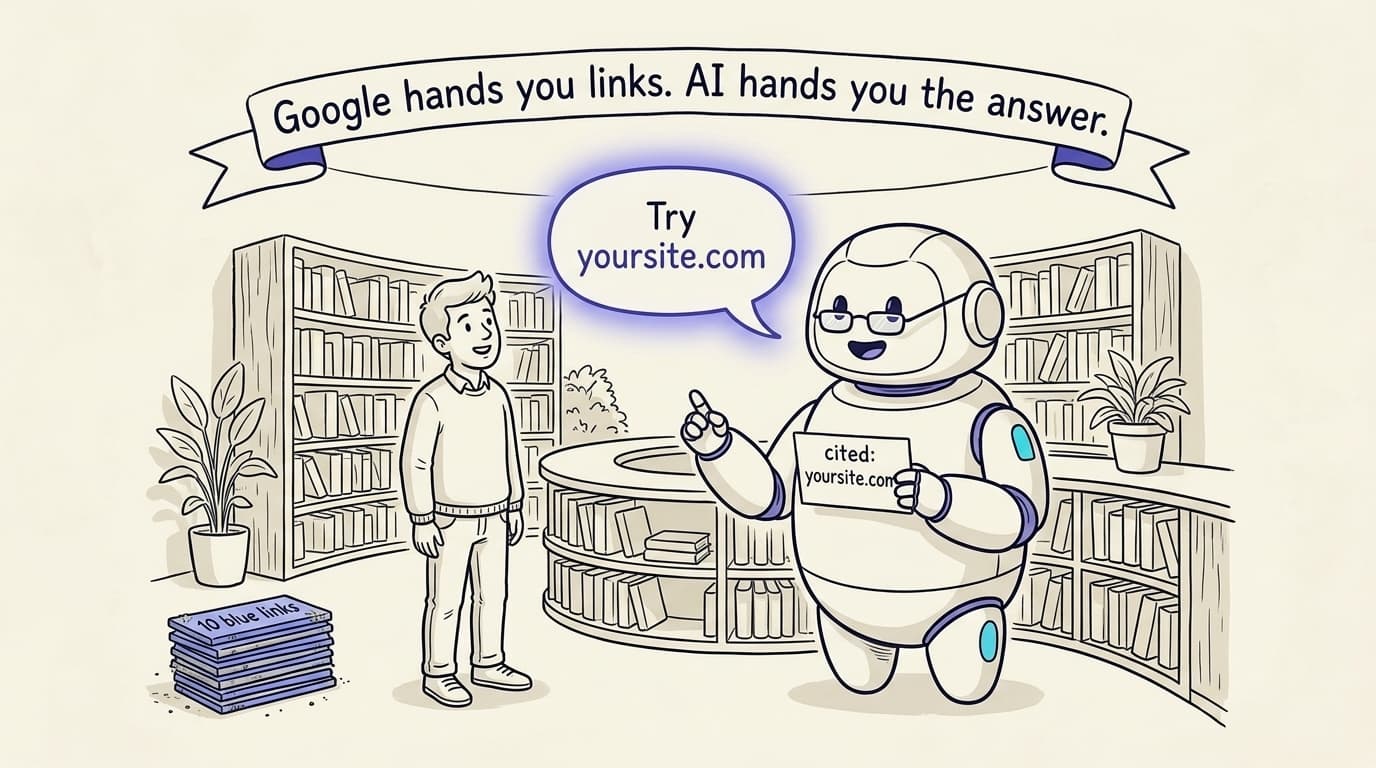
You will also hear it called AEO (answer engine optimization), LLM optimization, or AI SEO. They are all aiming at the same prize: AI search visibility, being surfaced and quoted when an AI answers your buyers' questions. The simplest way to picture it is this. A traditional search engine hands you ten blue links and sends you off to read them yourself. An AI engine reads them for you, gives you the answer out loud, and name-drops the sources it trusts. GEO is how you become a name it drops.
The shift is already large. ChatGPT alone has 900 million weekly users (OpenAI, February 2026), and roughly a third of people now start a search inside an AI tool. Yet the slots are wide open: in our own panel of 482 AI search queries, only 0.6% of non-brand queries cited any source at all. This post is the plain-English tour. What GEO is, how it relates to AEO and AI search visibility, how it differs from SEO, what actually gets a page quoted, and whether it is worth your time yet. Every number below is sourced.
What Is GEO, Exactly?
GEO is optimizing to be the cited source inside a generated answer, not a ranked link beside it.
Break the name down. Generative points at the engines that compose answers on the fly: the large language models behind ChatGPT, Claude, Perplexity, and Gemini. Engine optimization is the familiar half: shaping your content and your reputation so those engines choose you. Put together, GEO is the discipline of earning a mention and a citation when an AI writes an answer about your category. The unit of success is not a position on a results page. It is whether the model says your name and links your page.
The engines that matter today are ChatGPT and its Search mode, Perplexity, Claude, and Google AI Overviews, with Gemini close behind. They do not all work the same way, which is why "optimize for AI" is a meaningless instruction until you name the engine. But the goal is consistent across all of them: be the source the answer is built from, not a link the reader has to go chase.
Key takeaway
GEO earns the citation inside an AI answer, not a link beside it. The engines differ, but the goal is the same: be the source the model quotes when it answers your buyers.
GEO, AEO, and AI Search Visibility: What's the Difference?
Three terms, a lot of overlap, and one distinction that actually matters.
GEO (generative engine optimization) and AEO (answer engine optimization) are near-synonyms. GEO is the broader, more commonly searched term and stresses the generative model citing you; AEO stresses being the answer the engine gives. LLM optimization and "AI SEO" are two more names for the same work. Arguing about which acronym is correct is wasted energy. Treat them as one discipline aimed at AI answers.
The distinction worth holding is method versus outcome. GEO and AEO are the method, the things you do to your content and your off-site presence. AI search visibility is the outcome, how often AI engines actually surface and cite you. You do GEO; you measure AI search visibility. Our framework for the on-page method is the answer engine optimization page, and the tool that monitors the visibility outcome week to week is WhyIQ AI Radar.
0.6%
of non-brand queries cited any source at all, across our own 482-query AI search panel. AI search visibility is the outcome most brands have not built yet. WhyIQ citation panel, 2026
Key takeaway
GEO and AEO are the same discipline under different names. AI search visibility is the result you are chasing. Do the first to move the second.
How Is GEO Different From SEO?
They share most of their plumbing. They differ on what counts as winning.
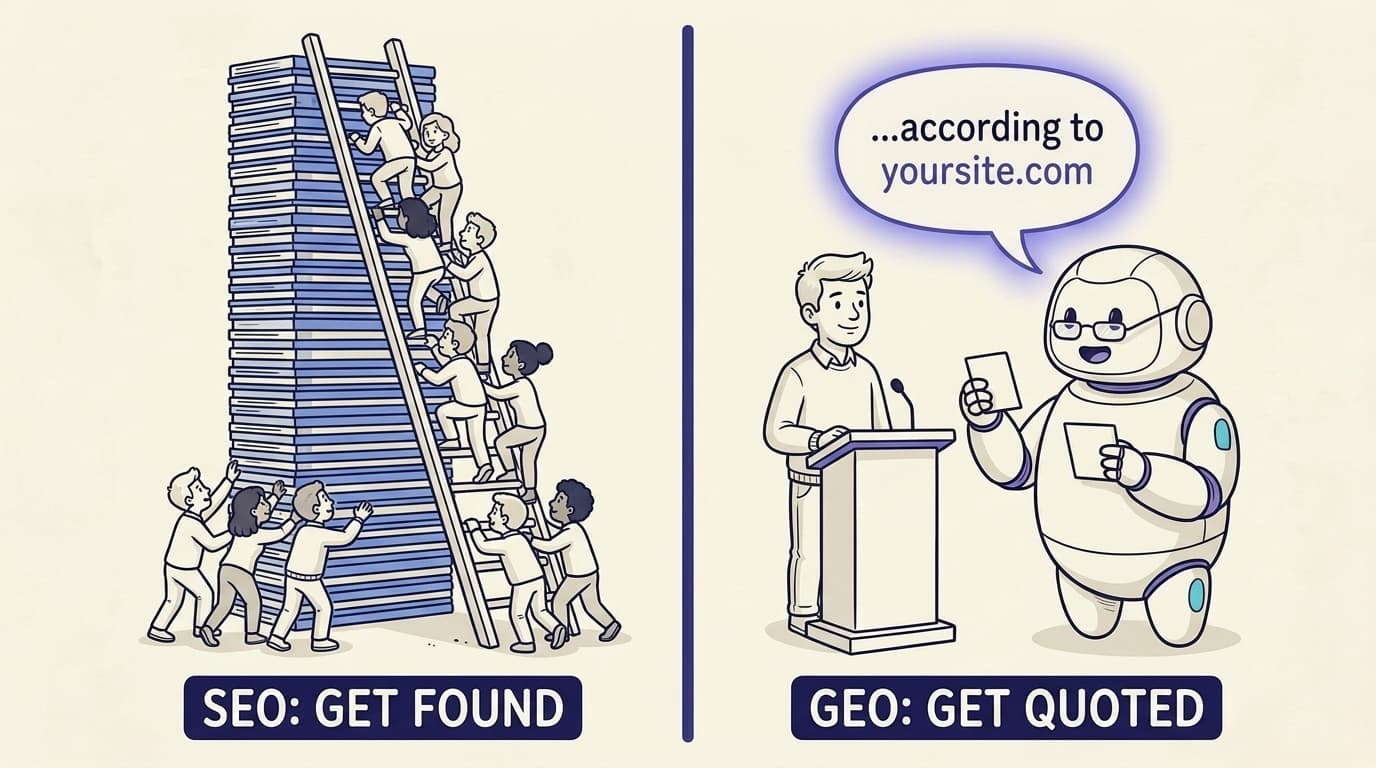
SEO optimizes to rank in a list of links; the win is a position. GEO optimizes to be the answer and the cited source; the win is a citation. The reason the two feel like one job is that they share a foundation. A page an AI engine cannot crawl, cannot parse, or treats as stale will not be cited, which is exactly what traditional SEO already solved. ChatGPT's Search citations overlap with Bing's top organic results 87% of the time (Seer Interactive, February 2026), so ranking is not a separate game; for some engines it is most of the game.
What genuinely diverged is the value of the click. When Google answers with an AI Overview, the user often never clicks through. Ahrefs measured a 58% drop in click-through for the number-one organic result when an AI Overview appears (2025). The position you fought for now hands its click to the answer box. That is the shift GEO responds to: ranking still matters, but it increasingly has to earn you a citation, not just a click. SEO is not dead. The free click is shrinking, and that is a different sentence.
58%
drop in click-through rate for the #1 organic result when an AI Overview appears. Ranking now has to earn a citation, not just a click. Ahrefs, 2025
Key takeaway
GEO and SEO share the technical foundation. They differ on the win condition: a ranked position versus a cited answer. As AI Overviews absorb the click, ranking now has to earn a citation too.
What Makes an AI Engine Quote Your Page?
Three signals do most of the work, and they are not the ones a decade of SEO trained you to chase.
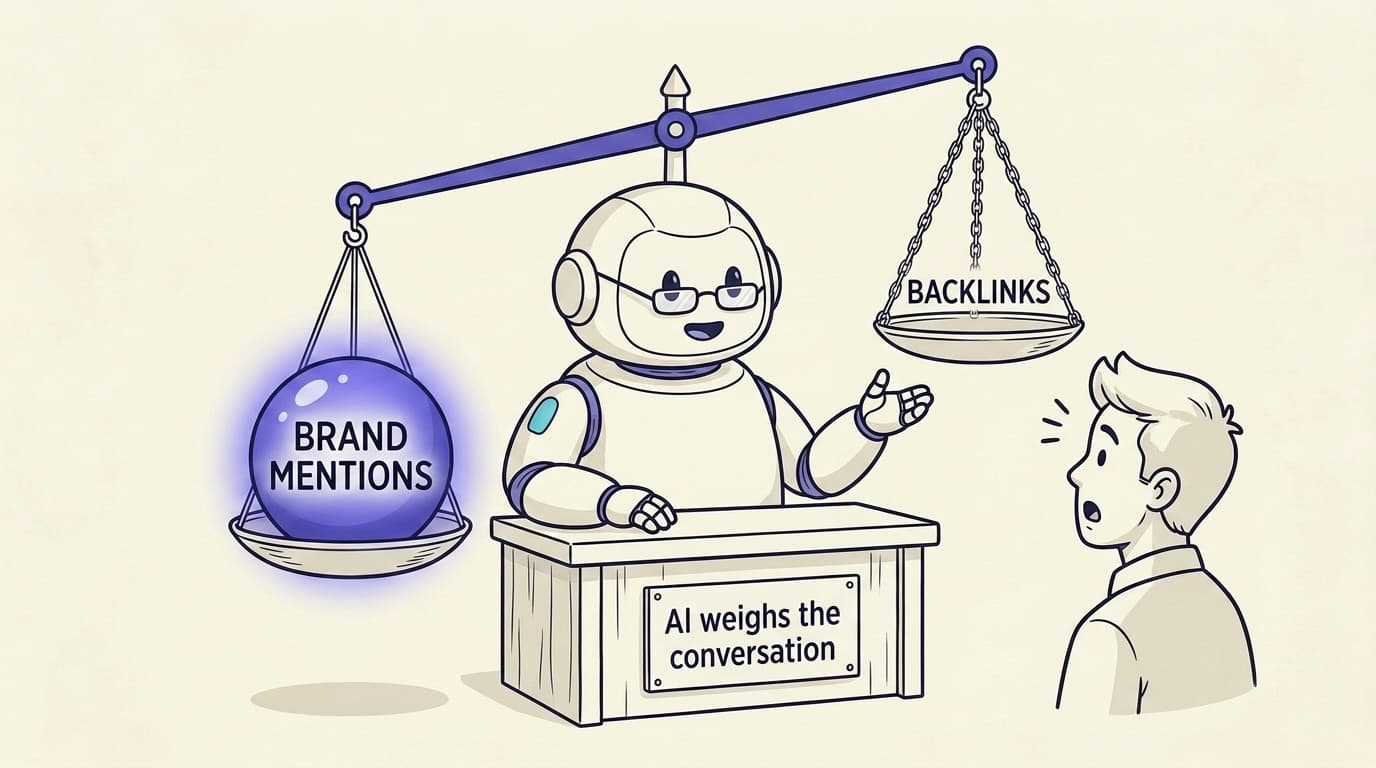
First, brand mentions beat backlinks. For twenty years authority meant who linked to you. AI engines learned authority from the open web of text, where brands get named in context, link or no link. Across 2025 studies, unlinked brand mentions correlate with AI citation at about r=0.664, against roughly r=0.218 for backlinks, a three-to-one gap. The Digital Bloom found brand search volume to be the single strongest predictor of citation (r=0.334).
Second, answer the question in your first paragraph. Models extract sentences, not whole pages, and they read top down: 44.2% of AI citations come from the first 30% of a page (Search Engine Land, 2025). Lead with a specific, sourced claim, not a warm-up. Third, raise your statistical density. Adding statistics lifts citation by 22%, quotations by 37%, and citing your own sources by 115% (Princeton GEO study, 2024). The full eight-signal picture, with weights, is in the AI Citability Playbook. These three are where most pages win or lose.
3x
Unlinked brand mentions correlate with AI citation about three times more strongly than backlinks (r=0.664 vs r=0.218). 2025 AI visibility studies (Soar/Wellows; Ahrefs across 75K brands)
Key takeaway
Earn brand mentions, lead with a sourced answer, and raise your statistical density. Those three signals decide most AI citations, and none of them is the backlink chase SEO taught you.
Why Should You Care About GEO?
Not because AI traffic is big yet. Because it is the highest-intent traffic you can get, and it is cheap to win right now.
Be honest about volume first: AI referral traffic is still roughly 1% of sessions for most sites. If you only count visits, GEO looks like a rounding error. The conversion case is the strong one. An analysis of 12 million visits found AI-referred visitors converted at 14.2%, against 2.8% for Google organic, about a 5x gap (Opollo and RankScience, 2026). The mechanism is obvious once you see it: someone who arrives because ChatGPT recommended you by name has already had the comparison done for them. They land pre-qualified.
Two more reasons. Buyers are migrating: roughly a third of people now start in an AI tool, and that share is climbing. And the moat is cheap while it is empty: with only 0.6% of non-brand queries citing anyone, the brands that build presence now lock in citations before their category gets crowded. The real question is not whether AI traffic is large yet. It is whether you can afford to be invisible in the channel that sends your highest-intent visitors, while winning it is still this easy.
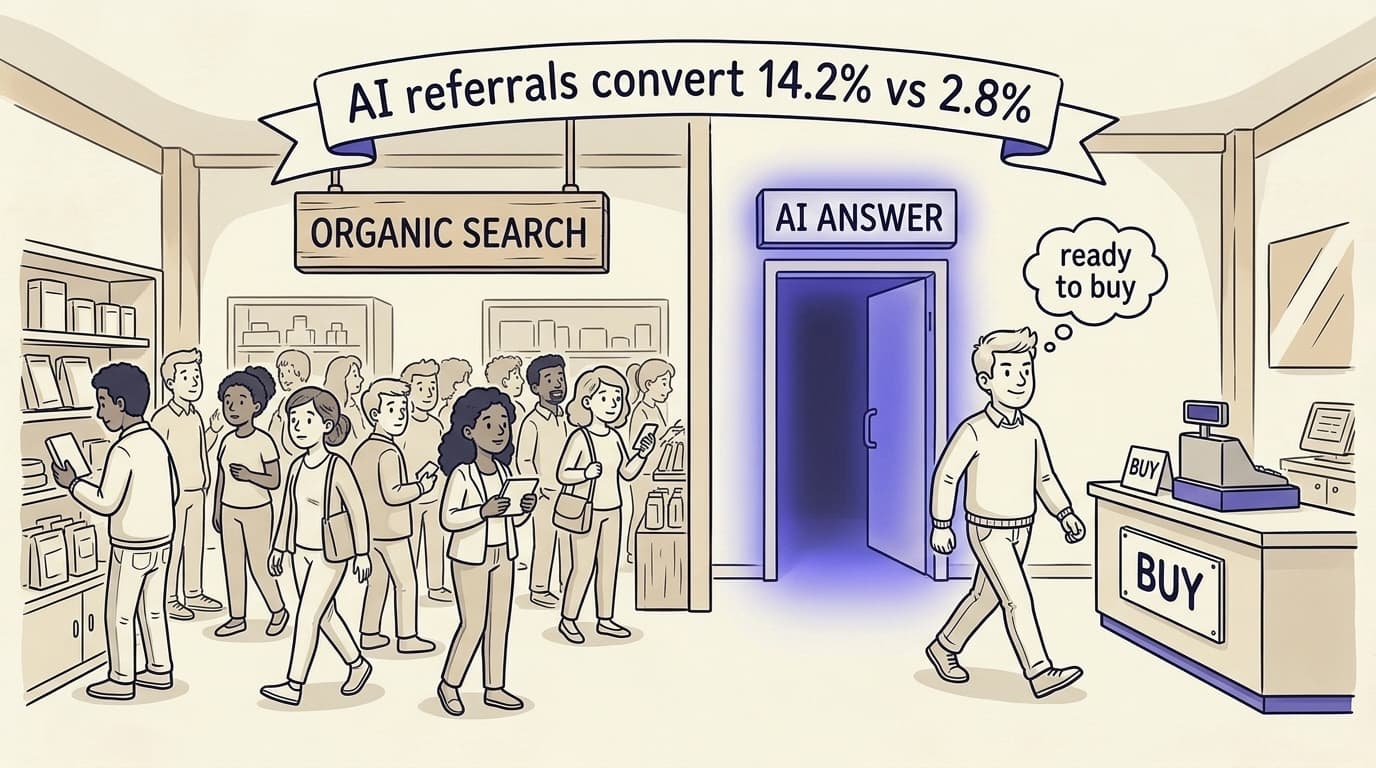
14.2% vs 2.8%
conversion rate for AI-referred visitors versus Google organic, across 12 million visits. Roughly a 5x gap. Opollo and RankScience, 2026
Key takeaway
GEO is not a volume play yet. It is an intent play. AI sends few visitors but they convert about 5x better, and the citation slots are still cheap to win.
Is GEO Right for You?
For most considered-purchase businesses, yes. For a few, not yet.
GEO pays off when your buyers ask AI engines for recommendations before they buy. That covers most B2B SaaS, professional services, considered consumer purchases, and anything with a comparison step. Founders and marketers in those categories are the core case, because ChatGPT, Perplexity, and Claude are already reaching their buyers. Agencies have a second reason: GEO is a service they can sell, and most clients have not started. Content teams optimizing for Google and AI at once get the best of it, because the foundation work serves both at once.
The honest caveat: if you have no organic foundation yet, do the SEO basics first. AI engines need a crawlable, server-rendered, reasonably fresh page before they can cite anything, so GEO with nothing underneath it is effort with no leverage. And if you sell pure impulse products to people who will never ask an AI for a recommendation, you can wait. Everyone else is better off starting while the slots are open.
Key takeaway
If your buyers research before they buy, GEO is for you now. If you have no SEO foundation, build that first. If you sell pure impulse with no comparison step, you can wait.
How to Get Started With GEO
Three moves you can start this week, then where to go for the full plan.
One, put a specific, sourced answer in the first paragraph of your most important pages. Not a warm-up sentence, the actual answer, with a number and a name in it. Two, keep your pages crawlable and server-rendered. If your headline, pricing, or proof renders only in client-side JavaScript, most AI crawlers see a blank page: GPTBot does not execute JavaScript, and Vercel found no evidence of rendering across more than 500 million fetches. Three, earn third-party brand presence. Claim your review-site listings, show up by name in the communities your buyers read, and get into the "best tools for X" roundups. Review-site presence alone lifted cited rate from 1.8% to 4.6-6.3% in one study (SE Ranking, 2025).
That is the on-ramp. The full method, the eight signals AI engines weigh and a 90-day plan, is in the AI Citability Playbook. The signal hierarchy and how we score a page sit on the answer engine optimization page, with the research behind it on our science page. To see whether engines actually cite you, WhyIQ AI Radar tracks it weekly. And if you want to know where your page stands today, a free WhyIQ scan scores your AI citability in about two minutes.
Stop optimizing to be found. Start optimizing to be quoted.
Frequently asked questions
Is GEO the same as AEO?
Effectively yes. GEO (generative engine optimization) and AEO (answer engine optimization) are near-synonyms for the same discipline. GEO emphasizes the generative model citing you; AEO emphasizes being the answer it gives. LLM optimization and AI SEO are two more names for it. Treat them as one practice.
What is AI search visibility?
AI search visibility is the outcome metric: how often AI engines actually surface and cite your brand. GEO and AEO are the methods you use to improve it. You do GEO; you measure AI search visibility. WhyIQ AI Radar tracks that real citation rate weekly across the major engines.
Does GEO replace SEO?
No. GEO layers on top of SEO. AI engines need a crawlable, server-rendered, reasonably fresh page before they can cite it, and several draw heavily on ranked results. The brands winning AI citation are overwhelmingly the ones already ranking organically. Do GEO on top of SEO, not instead of it.
Which AI engines does GEO target?
ChatGPT, Perplexity, Claude, Google AI Overviews, and Gemini. Perplexity and Claude cite sources most readily. Each pulls from a different source mix (Bing, Reddit, Google organic, the Knowledge Graph), so there is no single AI to optimize for. GEO is a presence-everywhere game.
Do I need backlinks for GEO?
Less than you would expect. Across 2025 studies, unlinked brand mentions correlate with AI citation about three times more strongly than backlinks (r=0.664 versus r=0.218). Backlinks still help your SEO foundation, but for AI citation, being named by name in trusted third-party content matters more.
How long until GEO works?
Usually weeks to a few months. The catch is decay: the median AI citation half-life is about 4.5 weeks, so GEO is ongoing maintenance, not a one-time fix. Refresh your most important pages on a calendar and keep earning third-party mentions to hold the citations you win.
Can I do GEO myself?
Yes. Start with three free moves: put a specific, sourced answer in your first paragraph, keep your pages crawlable and server-rendered, and earn third-party brand presence on review sites, communities, and listicles. No tool is required to begin. A tool helps you measure whether it worked.
How do I measure GEO?
Measure two things. Readiness: whether your page carries the on-page signals AI engines reward, which a WhyIQ scan scores in about two minutes. Reality: whether engines actually cite you on the queries that matter, which WhyIQ AI Radar monitors weekly. The first tells you if you built the moat, the second if it is holding.
Go deeper
For the strategic question everyone asks next, see answer engine optimization vs generative engine optimization. The data behind the brand-mention finding is in why ChatGPT cites some sources, and the full implementation is in the AI Citability Playbook.