
Most AEO strategies are a keyword list with question marks bolted on. That is backwards. An AEO strategy should start with what your business wants to sell more of, and the prompts you track should be the questions a buyer of exactly that thing would type into ChatGPT, Perplexity, Claude, Gemini or Google's AI Mode. Pick them for specificity and fit with revenue, not for search volume. Keep roughly nine in ten unbranded, because the questions that name you are the ones you already win.
The numbers on that last point are blunt. In a study of 57.2 million AI citations, a brand's own content showed up in 77.6 percent of answers to questions that named it. On unbranded discovery questions, just 2.2 percent of citations pointed at brand-owned sites (Foundation and AirOps, 2026). Branded prompts make a dashboard look healthy. Unbranded ones are where new customers make up their minds, and where a rival is usually holding the answer. Here is the method in seven steps, with one made-up business carried all the way through.
2.2%
of AI citations on unbranded discovery questions point at brand-owned sites. On questions that name the brand, its own content appears in 77.6% of answers. Foundation and AirOps, 57.2M citations, 2026
Why Does an AEO Strategy Start With What You Sell?
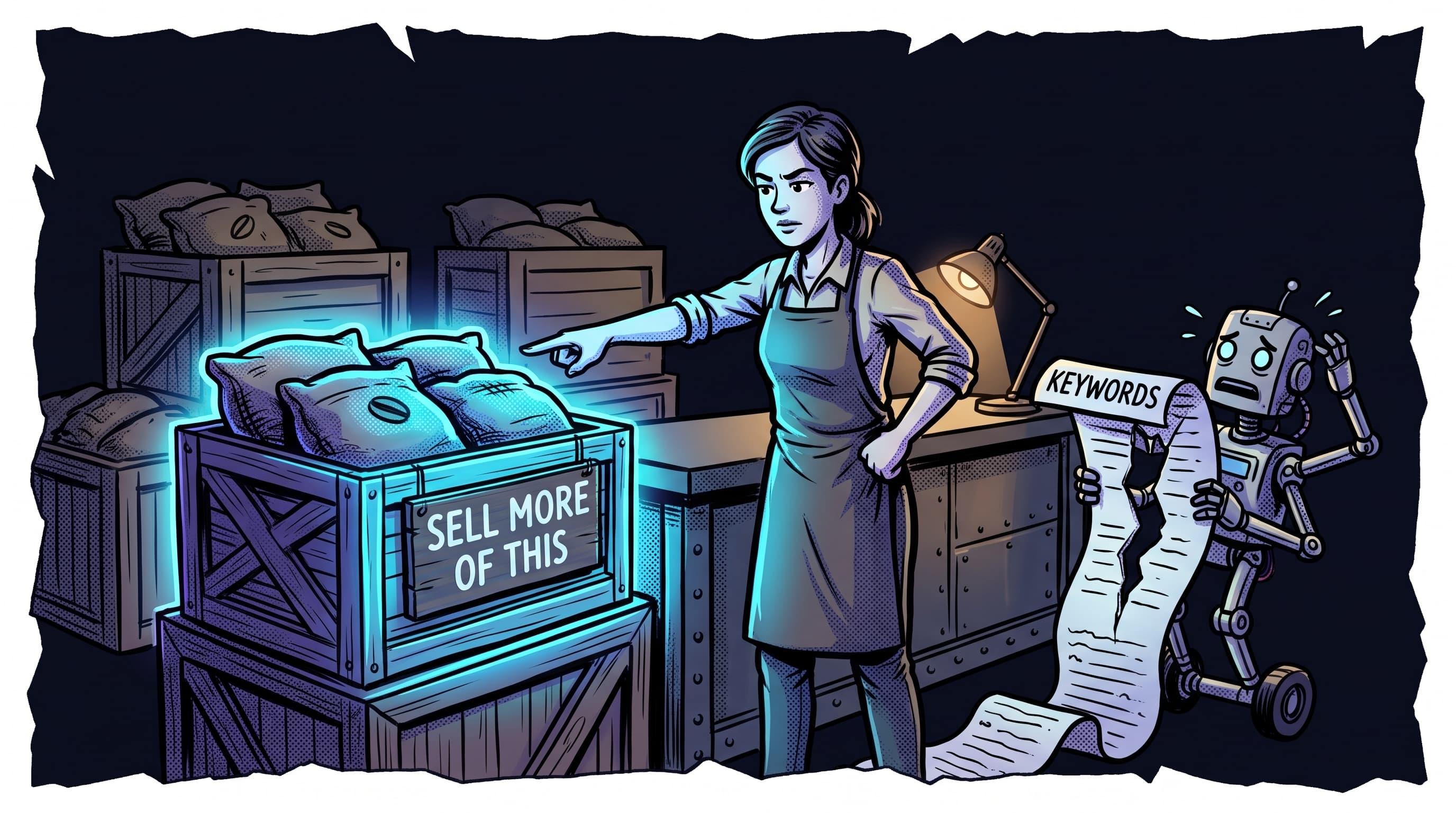
Because a prompt set is a decision about which customers you are trying to win. Write it before making that decision and you end up tracking whatever was easiest to think of.
Every business has a line it would happily sell twice as much of: the product with the best margin, the service with the biggest order value, the stock that is easy to source, the customer type that renews. Start there. Write that line down, and the one or two after it, before you write a single prompt.
Take a made-up coffee roaster with three lines. Home subscriptions are what people know it for. Wholesale supply to cafés carries the best margin and the steadiest volume. Espresso machine servicing keeps the wholesale clients loyal. Left alone, its team would track "best coffee subscription", because that is the line everyone thinks of first. The strategy says wholesale. So most of the prompt set goes on the questions a café owner asks when choosing a supplier, and subscriptions get a smaller share. The prompts follow the plan, not the other way round.
How Do You Audit the Prompts You Already Track?
Five checks, ten minutes. Most prompt sets fail at least two.
One: count the prompts with your brand name in them. More than about one in ten and your headline number is flattering you. Two: read each prompt aloud. If it sounds like a keyword wearing a question mark ("crm small business?"), no buyer typed it. Three: list everything you sell and mark the lines with no prompts at all. An uncovered line is invisible by design. Four: check what you record. "Did we appear?" is half a result. The other half is who appeared instead, because that rival is your target list. Five: check when each prompt was added. If nothing has ever been removed, the set has been drifting away from your business since the day it was written.
Fix the failures before adding anything new. A bigger set built on the same mistakes just measures them at greater expense.
What Does a Real Buyer Prompt Look Like?
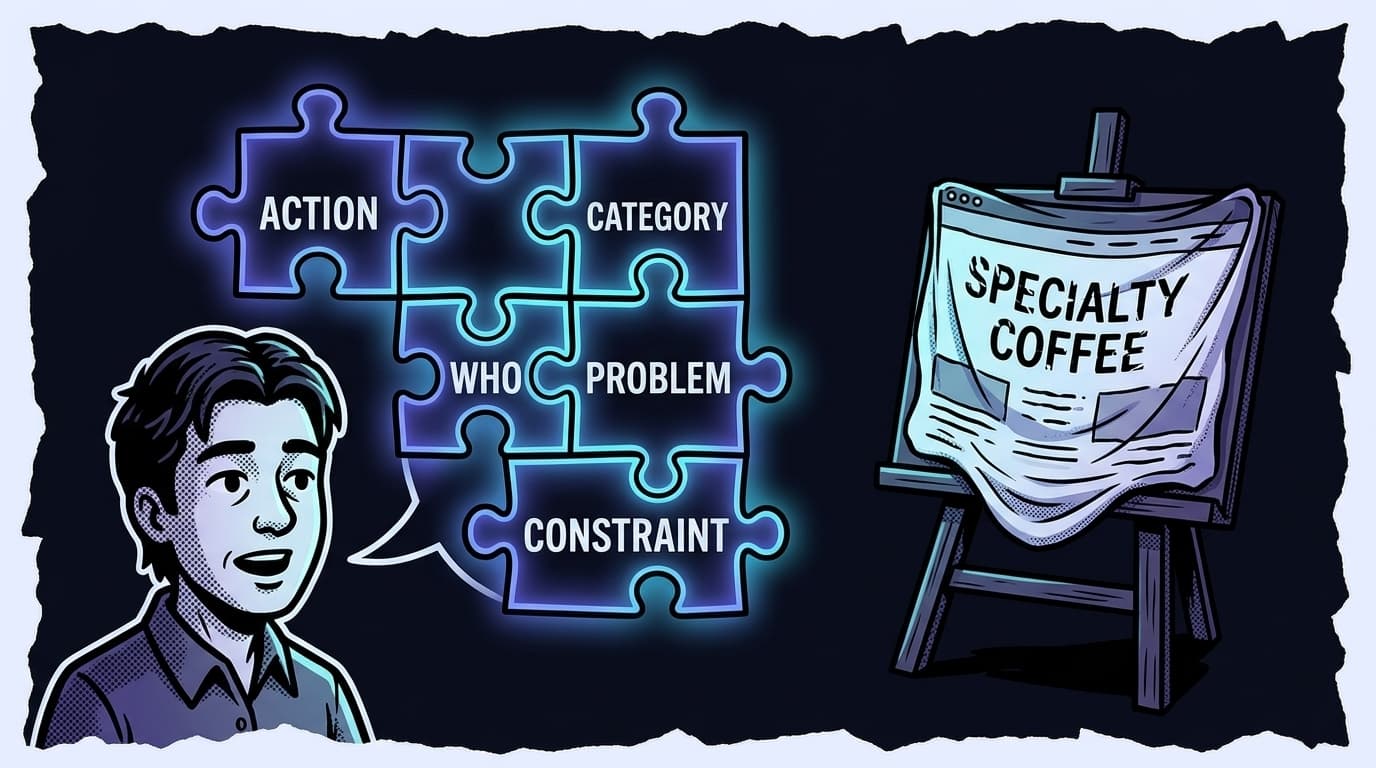
A buyer prompt is one sentence with five parts packed into it. A keyword usually carries one.
Here is a question a café owner might type: "Recommend a coffee roaster that supplies small independent cafés, delivers every week and trains new baristas, because our current supplier keeps turning up late." Break it apart. The action is recommend. The category is wholesale coffee roaster. Who is asking: a small independent café. The problem: late deliveries. The constraints: weekly delivery and barista training.
Now picture the roaster's wholesale page. If it says "premium specialty coffee, ethically sourced" and little else, it matches none of those five parts, so the engine has nothing to cite it for, however good the beans are. Not every prompt needs all five, either. Real buyers also type short, search-shaped questions, so a healthy set keeps a mix of lengths. But a set where nothing carries a problem or a constraint is measuring keywords dressed up as questions. That gap is the subject of buyer-intent prompts vs SEO keywords.
How Do You Turn Your Business Into a List of Prompts?
Use your own navigation as the map. Then treat every prompt as a combination of three things.
Your site menu already lists what you sell: products, services, use cases, industries. Each branch is a door a buyer can walk in through, so each branch needs prompts. The roaster's menu reads Wholesale, Subscriptions, Machine Servicing and Training. That is four branches, and a prompt set that only covers Subscriptions ignores three of them.
Then build each prompt from three slots: the offering, who is buying it, and the situation they are in. Wholesale beans, for a café opening a second site, that needs the same taste in both. Wholesale beans, for an office, that wants the supplier to look after the grinder too. Swap one slot and you have the next question. Ten minutes with three columns gives you dozens of candidates per branch. Most will be bad. The gates further down exist to throw them out.
WhyIQ AI Radar now builds new question banks the same way: it reads your homepage and its navigation, names each product or service line in buyer language, and writes questions from an offering, customer and situation grid, so every line you sell gets questions of its own.
Where Do You Find the Words Buyers Actually Use?
Your own guesses are the weakest source. Five better ones are already lying around.
- Ask the engines. Ask ChatGPT or Perplexity what people usually ask when choosing a wholesale roaster, then ask again from another angle. The phrasing is rough, but it is phrasing the engine already knows.
- People Also Ask. The question boxes in Google's results show questions people search, grouped by topic, and they keep expanding as you open them.
- Reddit and forums. Read how your buyers describe the problem before they know any product exists. Reddit is also one of the domains AI engines cite most, so this wording is already in front of them.
- Sales and support conversations. Call notes, tickets and chat logs are the best source you own, because every one of them came from someone buying.
- Search Console. Filter the Performance report by query with a custom regex such as
^(\S+\s+){5,}\S+$to list queries of six words or more. Long questions that already reach your site come with proof that someone asks them.
Which Prompts Should You Throw Out?
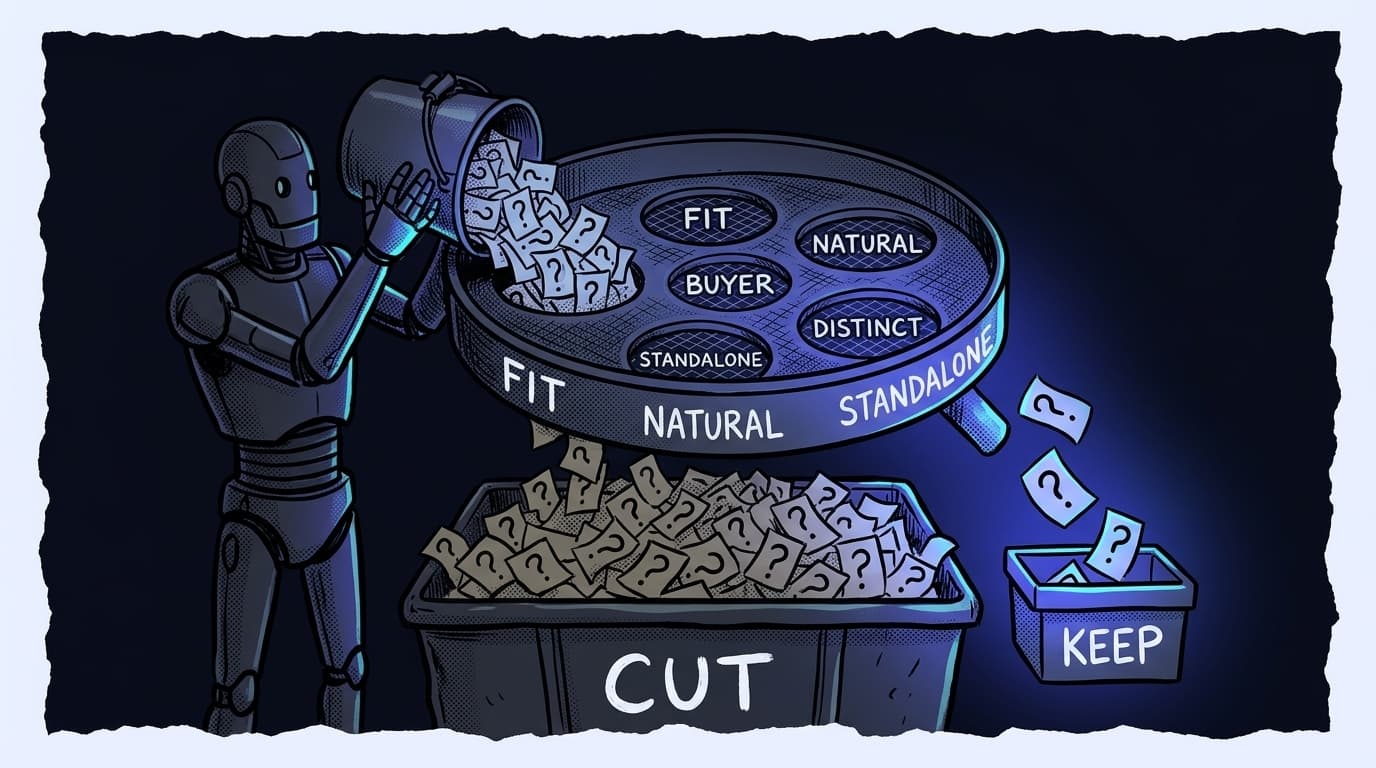
Every candidate passes five gates before it goes in. Expect most of them to fail.
Brand fit: would you actually want to be the answer? A roaster that does not do decaf should not track decaf questions, however popular they are. Buyer relevance: is the person asking someone who could buy from you, or a student writing about coffee history? Natural language: would a human type this, word for word? Stands on its own: does it make sense with no earlier conversation? Distinct: is it a new question, or one already in the set wearing different words?
The three-column grid produces combinations that look fine in a spreadsheet and fall apart read aloud. "Wholesale coffee for an office that wants barista training" is grammatical, and nobody has ever asked it. Cutting most of your candidates is not waste. It is the step that turns a list into a measurement.
| Candidate | Verdict | Why |
|---|---|---|
| "Which roaster can supply two cafés with the same blend every week?" | Kept | Specific, natural, a buyer with a real constraint |
| "coffee wholesale uk best?" | Cut | A keyword with a question mark |
| "What about the decaf ones?" | Cut | Needs an earlier conversation to mean anything |
| "When was the espresso machine invented?" | Cut | Not a buying question |
| "Top wholesale coffee suppliers for cafés" | Cut | Same question as one already in, reworded |
When Radar builds a question bank, it checks the questions it writes against these same tests before tracking them: something you sell, a real buying question, phrased the way a person types it, and makes sense on its own. Reworded repeats are left out.
Key takeaway
Map every line you sell, build each prompt from offering, buyer and situation, then gate every candidate. Cutting most of them is the method working.
How Do You Label Prompts by Intent?
Every prompt does one of three jobs: learning, comparing or buying. Each is won by a different kind of page.
Learn prompts ask how something works or what to do about a problem: "how often should a café service its espresso machine?" Guides and explainers win these. Consider prompts weigh options: "which wholesale roasters train baristas, and how do they compare?" Comparison pages, reviews and third-party roundups win these, and much of that evidence sits on other people's sites. Purchase prompts are ready to choose: "which roaster near Leeds can start weekly café deliveries this month?" Pricing pages, service pages and clear landing pages win these.
For a starting mix we weight towards buyers: roughly a fifth Learn, two fifths Consider, two fifths Purchase. A working heuristic, not a law: a brand nobody has heard of yet may need more Learn prompts first. The label matters more than the exact split, because it tells you which page to build when a prompt comes back empty.
Why Is the High-Volume Prompt Usually the Wrong One?
Because broad questions are crowded, vague about who is asking, and a long way from a purchase.
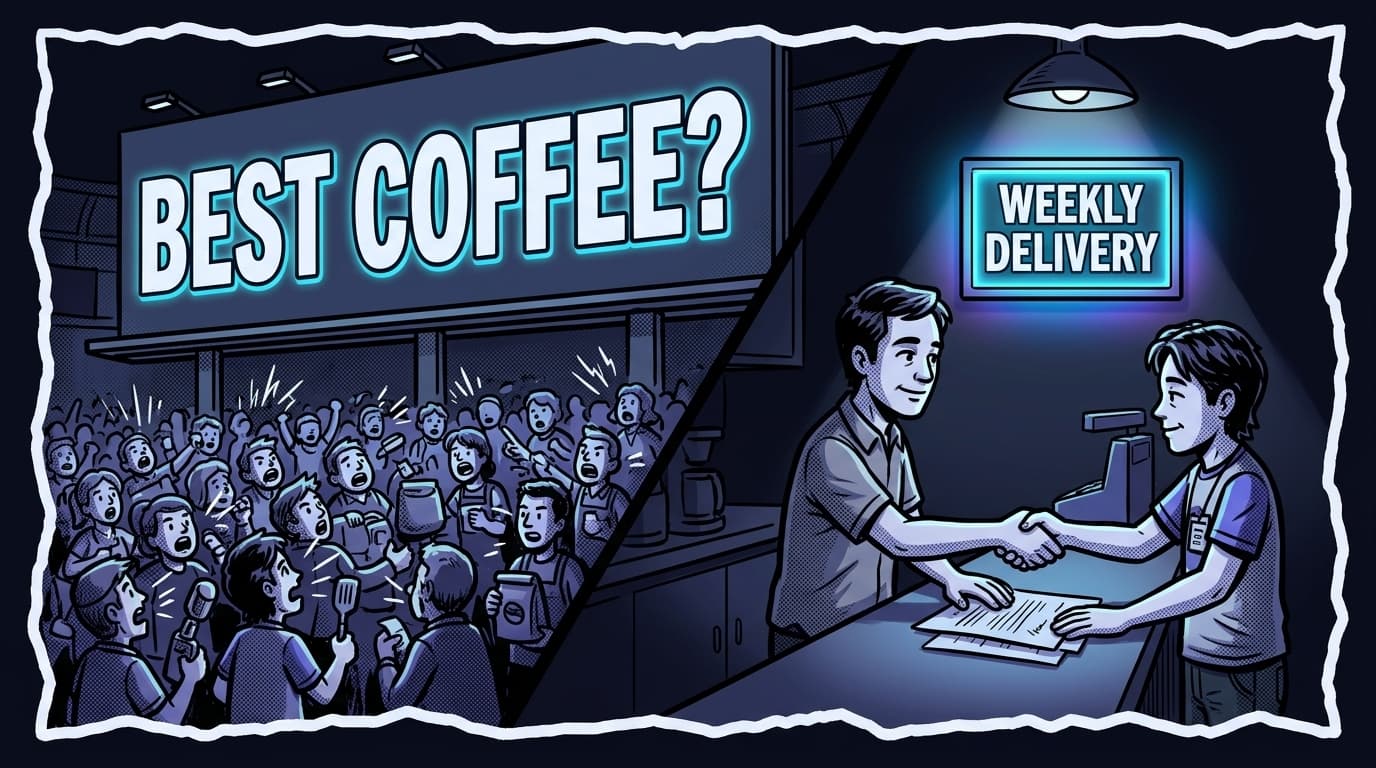
A keyword tool will always point you at the broad question: "best coffee beans". Huge interest, every roaster in the country fighting over it, and most people asking want one bag for home. Call it the vanity prompt. It looks great in a report and rarely moves revenue.
The revenue prompt is narrower: "which roaster supplies cafés with a house blend and looks after the grinder too?" Fewer people ask it. The ones who do are close to choosing, and far fewer brands are competing for the answer. Specific prompts are both more winnable and closer to a purchase, which is why specificity should carry the most weight when you rank your candidates. Volume is a tie-breaker, not the goal. Volume data for long, conversational questions barely exists anyway.
How Many of Your Prompts Should Name Your Brand?
About one in ten. Branded prompts are worth watching and not worth building a strategy around.
Branded prompts tell you how the engines describe you: whether they get your pricing model right, what they say you work with, whether they still repeat a complaint from years ago. Worth knowing. But you already win most of these questions. On branded queries the brand's own site takes the large majority of citations, against a sliver on unbranded discovery questions (Foundation and AirOps, 2026). So hold branded prompts at roughly a tenth of the set and report them separately. Mix them into the headline and your visibility number mostly measures whether people who already know you can find you. A fine thing to check. Not a growth strategy.
A branded prompt tells you how AI describes you. An unbranded one tells you whether AI recommends you to someone who has never heard of you.
How Many Prompts Should You Track, and When Do You Cut Them?
Enough to cover every line you sell. Coverage first, depth second.
There is no magic number, and any tool that charges per prompt has a reason to suggest a big one. The rule that holds up is coverage before depth: a few solid prompts on every line you care about beats thirty on the one line you happened to think of first. Add depth where the money is, which takes you back to the first question of all (what do you most want to sell?). Leave a little room for new questions as you hear them.
Then prune on a schedule. A prompt where no engine cites anyone useful for several weeks running is measuring nothing, so swap it for a better one. But never cut a question just because you keep losing it. If a rival is named week after week on a question your buyers ask, that is not a dead prompt. It is the clearest loss on the board, and the one your next page, comparison or third-party mention should go after.
What Should Your Baseline Record?
One row per prompt, per engine. Not one number per brand.
For each prompt on each engine, write down four things. Were you named or cited? Where did you sit: first recommendation, or a footnote? Who was named instead? And what was the top source the engine leaned on: your page, a rival's page, a review site, a Reddit thread? Even a modest prompt set across five engines runs to a few hundred rows. That table is where the strategy lives.
Keep it per engine, because the engines disagree. A café owner asking ChatGPT and one asking Perplexity can be handed different roasters built from different sources, and those gaps need different fixes, as what each AI engine wants lays out. The last column is where the work comes from. When the top source is someone else's comparison page, the move is off your site. When it is a rival's service page, you need a better one. Average all of that into a single brand score and it disappears.
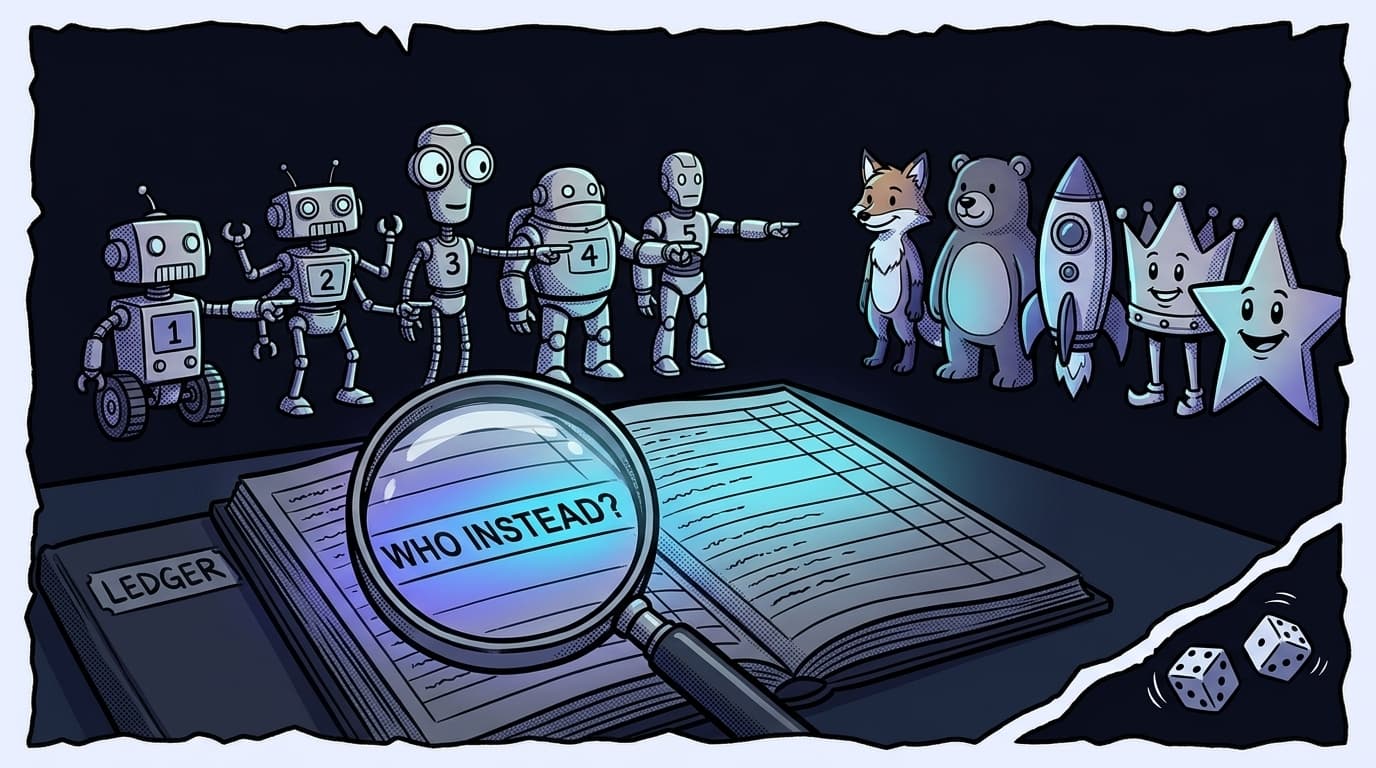
Why Can't You Trust a Single Check?
Because the same question can get a different answer an hour later.
AI answers are sampled, not looked up. Only 30 percent of brands stay visible from one run to the next, and more than half of the brands that drop out resurface within two runs (AirOps, 2026). Month to month, 40 to 60 percent of cited domains change (Profound, June vs July 2025). So a baseline built from one check per prompt is one roll of the dice per row, which is why ChatGPT gives different answers to the same question.
30%
of brands stay visible from one AI run to the next. More than half of those that drop out resurface within two runs. AirOps, 2026 State of AI Search
Two habits fix most of it. Run each prompt more than once and record how often you were named, not a yes or a no; we explain the approach in the 3-pass confidence band. And compare week to week rather than check to check, because citations move on the timescale of crawls and new mentions, not hours. A new page or a fresh third-party mention usually takes weeks to show up in answers. That is a reason to start the baseline now, not a reason to wait.
Key takeaway
One row per prompt per engine: named or not, position, who instead, top source. Run each prompt more than once and read the trend weekly.
Where Does WhyIQ Fit?
WhyIQ AI Radar does the measuring half of this method every week. The strategy half is yours.
AI Radar runs a set of buyer questions in your category on ChatGPT, Perplexity, Claude, Gemini and Google's AI Mode every week, and reads back the sources each engine actually cited. On the Agency tier each question runs three times per engine, so a result is a band rather than a single roll. Every question carries an intent stage. Brand questions sit in their own bank and are scored separately, so they never inflate your discovery number. When a rival is cited where you were not, Radar names the domain and the page. Questions where nobody gets cited for weeks are flagged with suggested replacements, while questions a rival keeps winning stay in on purpose.
Radar now builds new question banks with the method in this post: it maps each product line off your homepage navigation, checks the questions it writes against the tests above, ranks what is left by specificity and buying intent (and by the line you most want to sell, if you tell it), and keeps questions that name your brand to at most one in ten of your scanned slots.
For the pages themselves, the WhyIQ Scanner's AI Citability Index predicts how ready a page is to be cited, from on-page signals. It is a prediction, not a count of citations, and our methodology page says so in those words. Measure first, then fix.
Frequently asked questions
Which prompts should I track for AEO?
Track the questions a buyer of the product or service you most want to sell would type into ChatGPT, Perplexity, Claude, Gemini or Google's AI Mode. Write them in buyer language, cover every line you sell, keep roughly nine in ten unbranded, and pick by specificity and fit with revenue rather than by search volume.
What is an AEO strategy?
An AEO strategy is a plan for getting your business named and cited in AI answers. It starts with what you most want to sell, picks the buyer questions for those products, records who wins each answer on each engine, then builds the pages and third-party mentions that close the gaps, and checks again.
How do I find real buyer prompts?
Use five sources before your own guesses: ask the AI engines what buyers in your category ask, read People Also Ask boxes, search Reddit and trade forums, mine sales calls, support tickets and chat logs, and filter Search Console for queries of six words or more. Then cut anything that fails the five gates.
How many prompts should I track for AEO?
Enough to cover every product or service line you care about, with extra depth on the lines that matter most to revenue. There is no evidence-backed magic number. A few strong prompts on every line beats a large set concentrated on one, and a set you prune on a schedule beats a bigger one nobody maintains.
Should my AEO prompts include my brand name?
Keep it to roughly one in ten. Branded prompts show how engines describe you, which is worth watching, but you already win most of them. In a 57.2-million-citation study, a brand's own content appeared in 77.6 percent of answers to branded questions, while brand-owned sites drew just 2.2 percent of citations on unbranded discovery questions (Foundation and AirOps, 2026).
What is the difference between a vanity prompt and a revenue prompt?
A vanity prompt is broad and popular, like "best coffee beans": crowded, vague about who is asking, and far from a purchase. A revenue prompt names who is buying, their problem and their constraint. Fewer people ask it, but they are closer to choosing and fewer brands compete for the answer, so it is easier to win.
What intent mix should my prompt set have?
A buyer-weighted starting point is about a fifth Learn prompts, two fifths Consider and two fifths Purchase. Treat it as a working heuristic: a brand new to its category may need more Learn prompts at first. Label every prompt anyway, because the label tells you which page wins it: a guide, a comparison, or a pricing or landing page.
When should I remove a prompt from my AEO tracking?
Remove a prompt when it has produced no useful signal for several weeks, for example when no engine cites anyone relevant, or when it no longer fits what you sell. Never remove one just because a rival keeps winning it. That is a real loss on a question your buyers ask, and the clearest target you have.
Go deeper
For what the number on top of your prompt set actually means, see what an AI visibility score is. For why a rival holds the answer even when your page is better, see why AI doesn't cite you.