
Most "best AEO tips" lists published in late 2026 are still repeating dead 2025 folklore: ship an llms.txt file, stack FAQPage schema, obsess over Bing rankings as a ChatGPT shortcut, and pray. Those checklists miss the crawler changes Cloudflare, Google, and Bing shipped between August and October 2026, and they invert what actually earns citations.
The best Answer Engine Optimization (AEO) tips for November 2026 follow a strict order of operations: clear the silent technical exclusions that stop bots from fetching your page, earn the quote in the opening 30% of the copy with verifiable numbers, build third-party corroboration off your own domain, and measure unbranded buyer questions weekly across ChatGPT, Perplexity, Claude, Gemini, and Google AI Mode. Here are the nine moves that held up under our November evidence review, plus four tactics to drop from your sprint board immediately.
Summary: All 9 November 2026 AEO Tips Ranked
If you only fix one layer this week, start at row 01. Positive copy optimization cannot rescue a page that edge security rules or client-side JavaScript hide from retrieval crawlers.
| AEO tip | Priority | Engines affected | Core evidence |
|---|---|---|---|
| 01. Audit CDN, Search Console & robots.txt for late-2026 traps | Prerequisite | All 5 engines + Copilot | URL access 9.5/10 #1 factor (Zyppy, 2026); Cloudflare Sept 15 & GSC Aug 31 controls |
| 02. Server-render all citable answers, prices & tables | Prerequisite | ChatGPT, Claude, Perplexity | 69% of AI crawlers cannot execute JS (searchVIU, 1.3B requests) |
| 03. Put a self-contained answer in the opening 30% (and first 200 chars) | High-impact | ChatGPT, Google AIO/AI Mode | 44.2% of ChatGPT citations in first 30% (Kevin Indig, 2026); 9 in 10 Instant answers skip page open (RESONEO, 2026) |
| 04. Pack claims with named stats, quotes & primary citations | High-impact | ChatGPT, Perplexity, Gemini | +27% to +41% lift on main metric; +115% for rank-5 pages (Princeton GEO, KDD 2024) |
| 05. Structure H2s around buyer questions & fan-out sub-queries | Core structure | Google AI Mode/AIO, Perplexity | 2.8x higher citation rate with clean H1-H2 hierarchy (AirOps, 2026); only ~38% of AIO cites rank top 10 (Ahrefs, Mar 2026) |
| 06. Refresh key pages quarterly & push updates via IndexNow | Core structure | Perplexity, ChatGPT, Copilot | Over 3x higher citation-loss risk past 3 months without updates (AirOps, 2026) |
| 07. Earn third-party brand mentions on reviews, YouTube & Reddit | Highest ceiling | All 5 engines (Perplexity & AIO strongest) | r=0.66-0.71 web mentions vs r=0.218 backlinks (Ahrefs, 2025); 6.5x more likely cited via 3rd parties (AirOps, 2026) |
| 08. Claim Brave Search & drop promotional register for Claude | Under-used lever | Claude (Anthropic) | Brave listed as Anthropic web-search subprocessor alongside turbopuffer; neutral fluency lifted visibility (KDD 2024) |
| 09. Track 90%+ unbranded prompts across 5 engines weekly | Measurement | All 5 engines | 77.6% branded presence vs 2.2% unbranded citation share (Foundation & AirOps, 2026); 5.4% ChatGPT-Gemini overlap (arXiv, Sept 2026) |
Audit Cloudflare, Search Console, and robots.txt for Late-2026 Traps
A page an AI crawler cannot fetch cannot be cited, and three new dashboard switches shipped in late 2026 silently drop clean domains while their robots.txt file looks spotless.
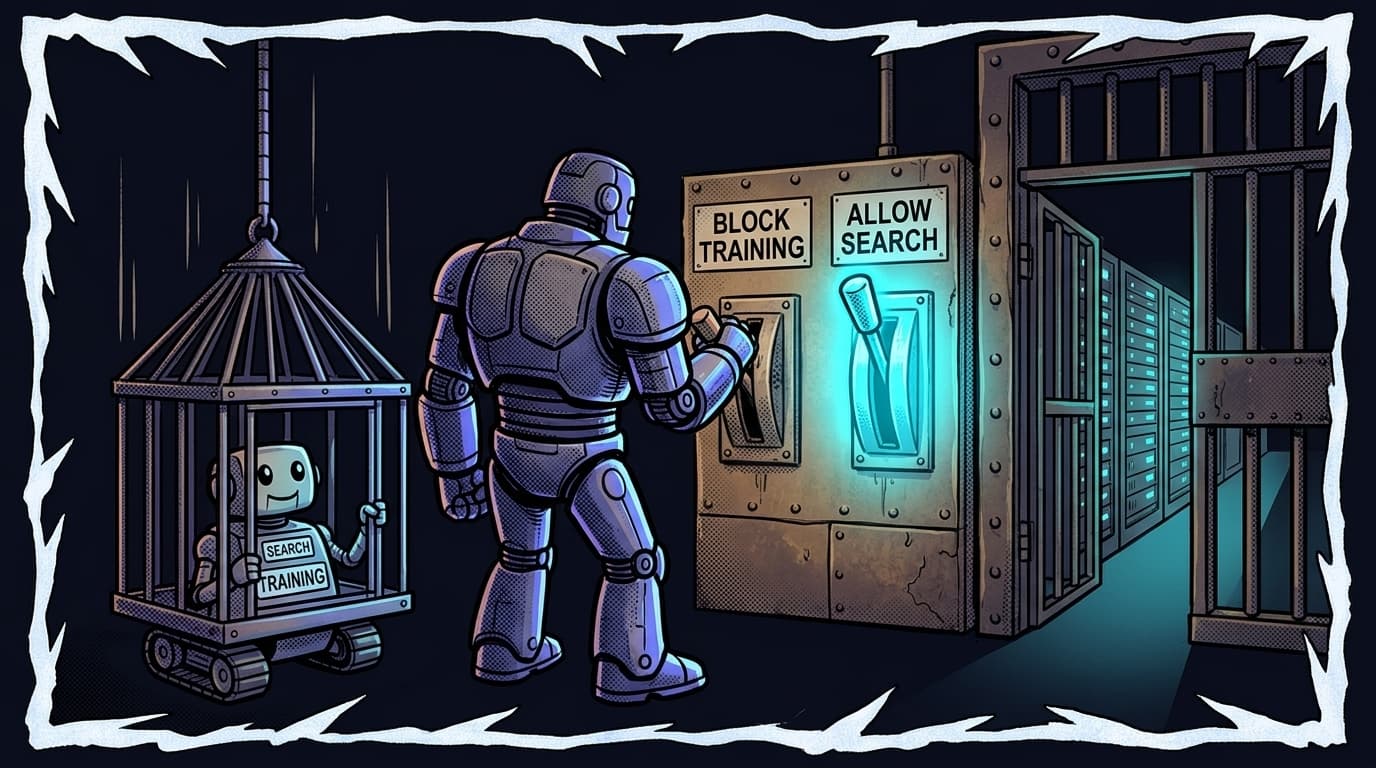
First, check Cloudflare's updated AI bot controls. Since 15 September 2026, Cloudflare treats Googlebot, Bingbot, and Applebot as mixed-use crawlers across search and training (Cloudflare, 2026). Choosing "Block" or "Block on pages with ads" under Training stops those mixed-use bots too, erasing your site from Google AI Overviews and organic Search together. Keep Search set to Allow, and use Disallow AI Training as your safe opt-out. Separately, verify edge WAF and Bot Fight Mode rules do not return HTTP 403 to OAI-SearchBot, Claude-SearchBot, PerplexityBot, or Bravebot.
Second, check three token rules that caught teams off guard this autumn. In Google Search Console (worldwide since 31 August 2026), open Settings > Search generative AI and confirm every property and subdomain is set to Include, not Exclude or an inherited Exclusion (Google, 2026). On Google-Extended, note that Google's October 2026 crawler documentation confirms it controls grounding inside Gemini Apps and Vertex AI Search as well as model training, whereas GPTBot and ClaudeBot remain training-only. Finally, never set a NOARCHIVE directive as a Bing training opt-out unless you are willing to vanish from Microsoft Copilot answers and grounding (Bing Webmaster Guidelines, 2026).
9.5 / 10
URL and crawler accessibility scored #1 across 23 AI citation factors in a 54-study meta-analysis. Zyppy / Cyrus Shepard, May 2026
Key takeaway
A green robots.txt file proves nothing on its own. Verify edge HTTP 200 responses for OAI-SearchBot, Claude-SearchBot, PerplexityBot, Bravebot, and Googlebot, set Cloudflare Training to Disallow AI Training (never Block), and verify Search Console's Search generative AI control is Include.
Server-Render Every Citable Answer, Table, and Price
Most AI search crawlers read raw server HTML and abandon copy that waits for client-side JavaScript hydration.
Across 1.3 billion crawler requests spanning 32 bots, searchVIU measured that 69% of AI crawlers cannot execute JavaScript. Vercel and MERJ's December 2024 crawl test confirmed the exact split: OAI-SearchBot, GPTBot, ChatGPT-User, ClaudeBot, and PerplexityBot fetch script files without executing them, while only Googlebot and Applebot run JS consistently.
If your comparison tables, FAQ accordions, pricing cards, or product claims load through React client state or tabs that inject DOM nodes after mount, ChatGPT, Claude, and Perplexity see an empty container. Inspect your high-intent URLs with curl or View Page Source rather than Chrome DevTools Inspect Element, and render critical copy in initial HTML via SSR or static generation. More technical detail sits in our AI crawler JavaScript breakdown.
Put a Self-Contained Answer in the First 30% (and First 200 Chars)
Marketing teams love a three-paragraph narrative warm-up, which is why product pages routinely lose citations to plain documentation that answers the prompt in sentence one.
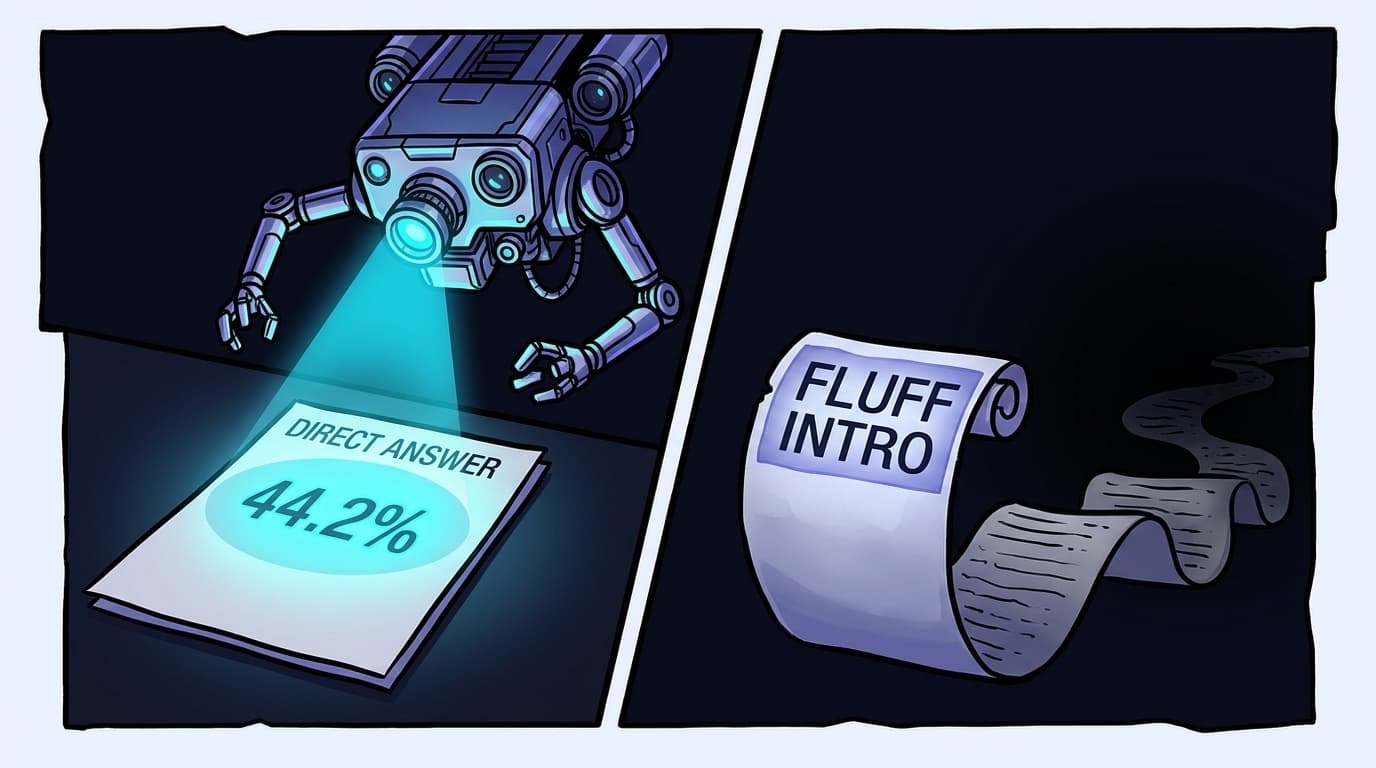
Kevin Indig's 2026 Growth Memo analysis of ChatGPT citations found 44.2% of citations were pulled from the first 30% of body copy, compared with 31.1% from the middle 40% and 24.7% from the final 30%. On fast retrieval paths the window is even tighter: RESONEO's 2026 audit of 1,249 answers showed nine out of ten ChatGPT Instant-mode responses never open the underlying page, working instead from an index snippet made of the page title and roughly 200 opening characters.
Open every commercial guide, comparison, and category page with a two-sentence answer block that states what the thing is, who it serves, and one hard number or price range. Save story and nuance for paragraph three.
44.2%
of ChatGPT citations come from the first 30% of a page's body text, versus 24.7% in the final 30%. Kevin Indig, Growth Memo analysis of ChatGPT citations, 2026
Key takeaway
Rewrite the top 200 characters of your highest-value pages so a retrieval model reading only the page title and first paragraph learns your exact answer, entity category, and proof point.
Pack Claims With Named Statistics, Quotes, and Primary Citations
Vague adjectives like "industry-leading" or "best-in-class" give a language model nothing neutral it can attribute.
In the peer-reviewed Princeton GEO benchmark (Aggarwal et al., KDD 2024, Table 1), adding quotations, statistics, or source citations raised generative visibility by 27% to 41% on Position-Adjusted Word Count: Quotation Addition gained +41% (+28% on Subjective Impression), Statistics Addition gained +31%, and Cite Sources gained +27%. Notably, citing sources lifted a fifth-ranked page by +115%, whereas a persuasive or authoritative writing tone produced no meaningful gain.
Note the engine nuance from Table 7 of the same study: on Perplexity specifically, quotations (+22% word count) and statistics (+37% subjective impression) held up cleanly, while external source citations scored lower on subjective impression. Use real first-party measurements, customer numbers you can stand behind, and named dated studies everywhere you state a claim. Never invent figures or stuff artificial citation templates; Bing's 2026 guidelines penalize artificially engineered citation language as spam.
Build Question H2s Around Query Fan-Out, Not Just Top-10 Rank
Classic organic rank no longer acts as a strict gatekeeper for AI citations, because answer engines split one buyer prompt into multiple parallel fan-out queries.
Ahrefs' March 2026 analysis of 4 million AI Overview citations showed only 37.9% of cited URLs ranked inside Google's organic top 10 (down from roughly 76% in July 2025), while 31.2% ranked in positions 11 to 100 and 31.0% sat beyond position 100. Because Google AI Mode, ChatGPT, and Perplexity issue adjacent sub-queries for price, alternatives, trade-offs, and limits, pages with one H1 and clean sequential question H2s earn 2.8x higher citation rates (AirOps, 2026; 87% of cited pages carry a single H1).
Structure each H2 around a real buyer question and write it as a self-contained 120-to-180-word section (sections in that range capture 70% more ChatGPT and Perplexity citations per SE Ranking, 2025). Put pricing boundaries, who your product is wrong for, and adjacent comparisons on the page as visible HTML so a single strong URL wins the fan-out queries.
Refresh Commercial Pages Every Quarter and Push via IndexNow
Stale comparison and category pages decay fast in retrieval ranking even when classic Google blue-link positions look steady.
AirOps' 2026 study found pages left more than three months without an update are over 3x more likely to lose AI citations, with over half of cited pages refreshed within six months and more than 70% within a year. Perplexity weights recency hardest of all, routinely favoring current-month dates over older authority posts.
Do not fake freshness by bumping a dateModified timestamp on an unchanged page. Schedule a real quarterly update for pricing, comparison, and "best of" pages: re-verify competitor tiers, swap in fresh screenshots or product capabilities, match your visible "Last updated" date with JSON-LD dateModified and sitemap lastmod, and ping IndexNow so Bing and Copilot pick up the revision the same day.
Earn Third-Party Mentions on Reddit, YouTube, Reviews, and Listicles
Even a technically flawless website hits an off-page ceiling if other domains never corroborate what you claim to be.
In AirOps' 2026 research, 85% of brand mentions inside AI answers came from external domains, and brands were 6.5x more likely to be cited through third-party sites than through their own domain. Across 75,000 brands, Ahrefs found branded web mentions correlated with AI Overview visibility at r=0.664 in May 2025 (nearly triple backlinks at r=0.218) and extended that finding in December 2025 to 0.66 to 0.71 across ChatGPT, Google AI Mode, and AI Overviews, with YouTube mentions strongest around 0.737.
On Perplexity specifically, Reddit and YouTube stand as the engine's two largest cited sources, roughly level with one another (Ahrefs, September 2026 top-50-domain share: reddit.com 21.6% and youtube.com 20.8%). Treat third-party authority as four concrete tracks: appear accurately inside comparison listicles that engines already cite, keep software directory and review profiles current with verified facts (vertical impact varies from under 1% to ~8% in 2026 B2B SaaS audits), publish focused YouTube walkthroughs, and answer real questions transparently on Reddit without fake accounts or astroturfing. See our breakdown of why Reddit threads beat vendor pages.
6.5x
more likely to be cited through third-party domains than through your own website, while 85% of brand mentions come from external sites. AirOps AI Search Report, 2026
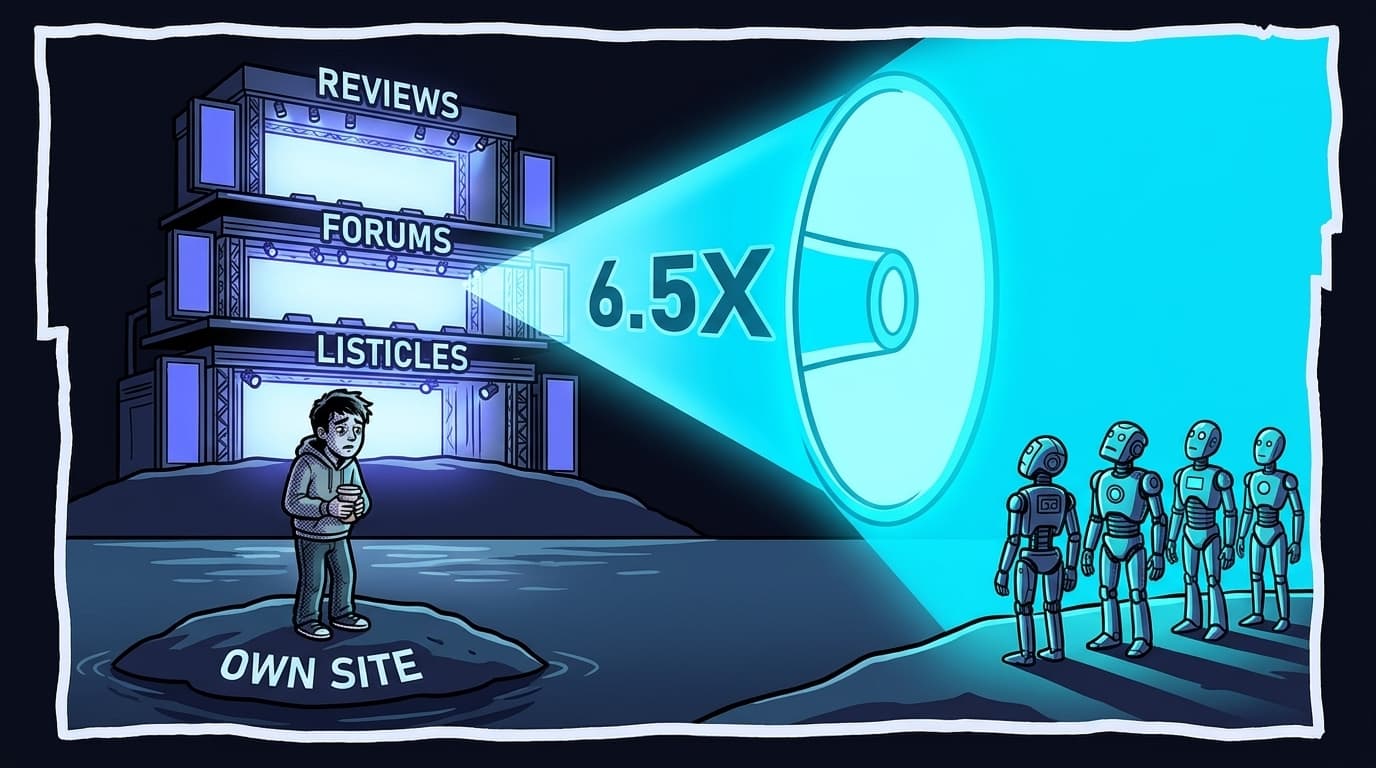
On-page AEO makes your site legible to extractors. Off-page corroboration gives the answer engine a reason to trust your brand more than the ten other legible sites in the pool.
Win Claude via Brave Search and Strip Promotional Fluff
Anthropic's Claude runs on a different retrieval stack than Google and ChatGPT, making it the single easiest engine where small brands can outmaneuver incumbents asleep on Google.
Anthropic lists Brave Search (alongside turbopuffer) as a web search subprocessor, and independent citation checks show heavy overlap between Claude's citations and Brave Search results. Most marketing teams verify Google Search Console and ignore Brave completely. Step one is verifying that neither Bravebot nor Claude-SearchBot is blocked in robots.txt or by Cloudflare WAF rules, then building clean crawlable pages and independent links that help Brave discover and rank your URLs.
Once Claude retrieves a candidate page, style decides whether a sentence survives synthesis. In Princeton GEO (KDD 2024), fluency optimization lifted visibility meaningfully (+28% on word count), while sales-heavy copy fails neutral answer synthesis. Replace superlatives with concrete trade-offs, plain numbers, and explicit boundaries on where a competitor fits better. For the full per-engine rulebook across all five engines, read what each AI engine wants before it cites you.
Measure Unbranded Prompts Weekly Across All 5 Engines
Typing your brand name into ChatGPT once is a coin flip disguised as analytics, and branded prompts hide where you are actually losing pipeline.
Foundation and AirOps' 57.2-million-citation study (2026) showed brand-owned sites appear in 77.6% of answers to queries naming the brand, yet capture just 2.2% of citations on unbranded buyer discovery questions. Meanwhile, engines barely agree with each other or even repeat themselves reliably: Uberti-Bona Marin et al. (arXiv, September 2026) found ChatGPT and Gemini shared only 5.4% of cited domains on identical shopping prompts, AirOps (2026) measured only 30% of brands staying visible from one run to the next, and Profound (June vs. July 2025) tracked 40 to 60% of cited domains turning over inside 30 days.
Build a prompt set that holds branded checks to 10% or less and dedicates the remaining 90% to realistic, constraint-rich buyer questions (who, problem, budget, alternatives). Track those prompts weekly across all five engines, record both Cited links and Mentioned brand names, and treat a shipped fix as Won only when citations hold across consecutive weekly runs. See how to select the right AEO prompts to track for the full gating workflow.
What to Stop Doing in November 2026: The 4-Tactic AEO Graveyard
Dropping wasted work buys you back engineering hours for the crawlability, opening-paragraph rewrites, and off-page mentions that actually shift visibility.
| Tactic to drop | How it still gets sold | November 2026 reality |
|---|---|---|
| llms.txt as an AEO ranking trick | Must-have markdown index for ChatGPT and Google AI | Google ignores it, and Ahrefs (June 2026, 137,210 domains) found 97% of llms.txt files received zero requests. Useful only as developer docs convenience for coding agents like Claude Code. |
| FAQPage and HowTo schema projects | Rich-snippet and AI-citation cheat code | Google retired HowTo rich results in September 2023 and retired FAQ rich results on 7 May 2026. Visible Q&A prose drives extraction; schema is just minor entity hygiene. |
| Chasing Bing rank as a ChatGPT proxy | Rank #1 on Bing to lock down ChatGPT answers | Mid-2026 ChatGPT retrieval fans out across multiple commercial fetch pipes and OpenAI indexes that shift by cohort. Allow OAI-SearchBot rather than treating Bing rank as the sole lever. |
| Unedited mass AI-generated pages | Programmatic query-per-page farms to flood AI search | Fails Google's non-commodity bar by design and triggers site-wide scaled-content spam risk across Google and Bing's expanded 2026 AI manipulation guidelines. |
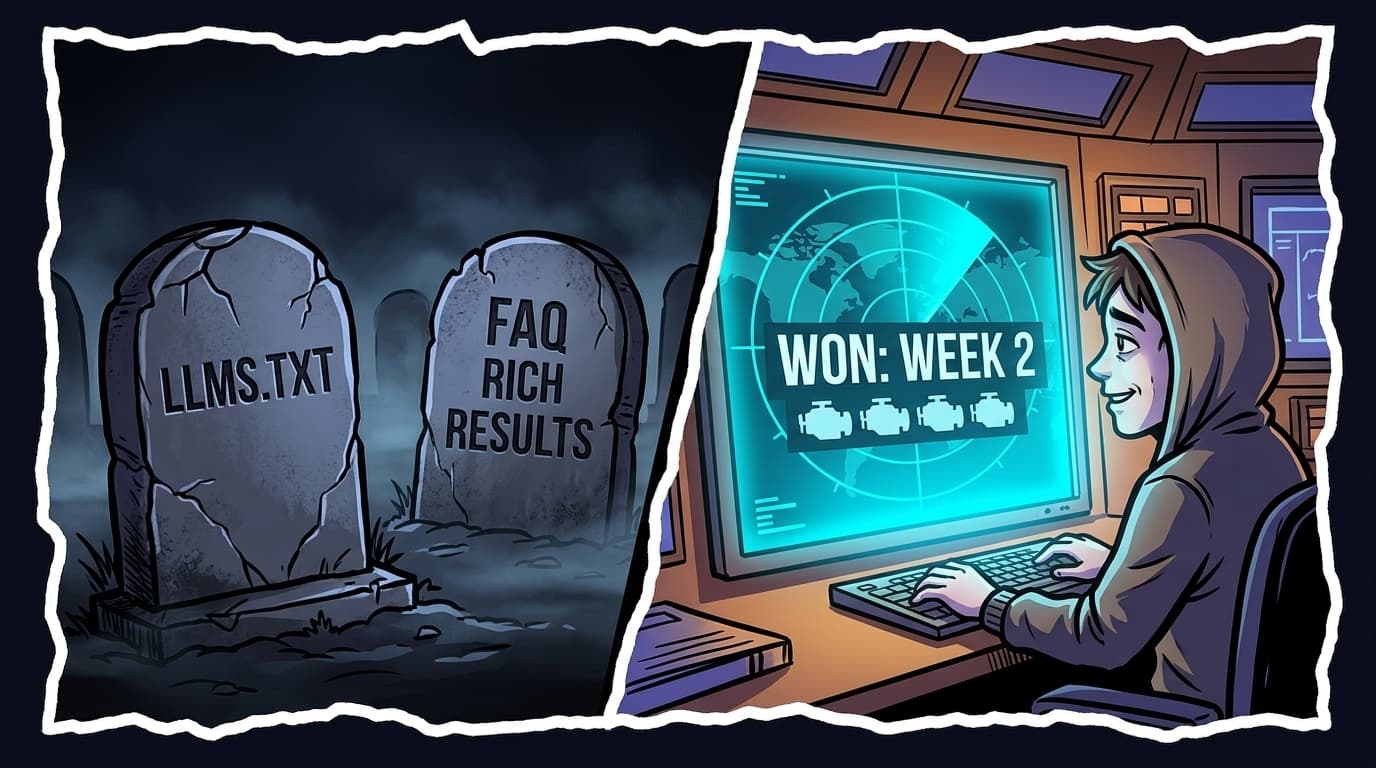
How to Audit Page Readiness and Measure Live AI Visibility Today for $0
Keeping measurement separate from page readiness prevents you from confusing a pretty score with real buyer visibility.
1. Measure live weekly AI visibility. WhyIQ AI Radar measures weekly AI visibility (the share of live answers that link to you as Cited or name you as Mentioned) across ChatGPT, Perplexity, Claude, Gemini, and Google AI Mode. Run a $0 baseline check with 9 unbranded buyer questions and 1 brand check (50 live answers streamed on screen in up to 10 minutes, email only). Ongoing weekly tracking starts at $12 in Month 1 at raw API cost, then $29/mo flat across all 5 engines on Radar pricing, with 2-week consecutive confirmation before marking any fix Won.
2. Predict on-page readiness and fix conversion gaps. The WhyIQ CRO Scanner is a separate instrument: it predicts on-page readiness heuristically through an 8-signal AI Citability Index (it is not a count of live LLM citations, as detailed on our science page) and simulates 50 visitors across 21 archetypes through your page to score Clarity, bounce rate, and CTA Pull (0 to 100). Your first scan is free with just your email, and you can apply verified fixes through 1-click WhyIQ Autopilot (/mcp) under our 4-Mode Switchboard and [fill in: ...] Honesty Gate.
Frequently asked questions
What are the most effective Answer Engine Optimization (AEO) tips in November 2026?
Start with crawler access, because a page an engine cannot fetch cannot be cited. Unblock search-tier bots in robots.txt and at your CDN, verify Search Console's Search generative AI control is set to Include, and server-render core copy. Next, place a direct answer in the opening 30% of the page, support claims with sourced statistics and quotations, build third-party brand mentions on community and comparison sites, and measure unbranded buyer prompts weekly across all five major engines.
Why did my site disappear from AI Overviews or ChatGPT after updating Cloudflare settings?
Since 15 September 2026, Cloudflare classifies Googlebot, Bingbot, and Applebot as mixed-use crawlers across both search and training. Choosing Block or Block on pages with ads for Training now blocks those mixed-use crawlers too, cutting your site out of Google AI Overviews and organic Search. Set Search to Allow and use Disallow AI Training instead of Block, and check that OAI-SearchBot and Claude-SearchBot return HTTP 200 at your edge.
Does llms.txt or FAQPage schema help you get cited by ChatGPT and Google AI in 2026?
Neither one is a reliable citation lever. Google states that Search ignores llms.txt, and Ahrefs' June 2026 study of 137,210 domains found 97% of llms.txt files received zero requests (though coding agents like Claude Code do read them for developer docs). Google also retired FAQ rich results on 7 May 2026. Visible question-and-answer content is what AI models extract, while schema acts only as an optional entity-clarity bonus.
Where on a page should you put the direct answer for maximum AI citation lift?
Put your clearest, self-contained answer in the first paragraph under the H1 and keep key claims inside the top 30% of body copy. Kevin Indig's 2026 Growth Memo analysis of ChatGPT citations found 44.2% came from the first 30% of the text, versus 31.1% from the middle 40% and 24.7% from the final 30%. On ChatGPT Instant mode, RESONEO (2026) found nine in ten answers never open the page, relying on the title and roughly 200 opening characters.
Do backlinks or brand mentions matter more for Answer Engine Optimization?
Off-domain brand mentions correlate far more strongly with AI answer visibility than link metrics. Ahrefs' 75,000-brand study (May 2025) measured brand mentions correlating with AI Overviews visibility at r=0.664, roughly three times the correlation of backlinks (r=0.218), and its December 2025 extension found 0.66 to 0.71 across ChatGPT, Google AI Mode, and AI Overviews (with YouTube mentions highest near 0.737). Backlinks still support core search ranking, while external mentions drive entity selection.
How do you optimize specifically for Perplexity and Anthropic's Claude?
For Perplexity, keep commercial pages refreshed at least quarterly (pages unupdated for over three months are over 3x more likely to lose citations per AirOps 2026) and participate honestly on Reddit and YouTube, Perplexity's two largest sources. For Claude, allow both Claude-SearchBot and Bravebot, server-render HTML cleanly, write in a neutral, specific register without marketing fluff, and make sure your site is discoverable in Brave Search.
How do you measure whether your AEO tips and page fixes actually worked?
Separate on-page readiness from live answer outcomes. WhyIQ CRO Scanner predicts page readiness heuristically across 8 AI Citability signals alongside a 50-visitor conversion simulation. WhyIQ AI Radar measures actual weekly AI visibility (the share of answers that named you as Mentioned or linked you as Cited) across ChatGPT, Perplexity, Claude, Gemini, and Google AI Mode, marking a fix Won only after two consecutive weekly scans confirm the citation holds.
Go deeper
Inspect all 8 on-page readiness signals in the AI Citability Playbook, understand the full AEO and GEO framework, or compare tracker pricing and limits in how much AEO costs in 2026.