
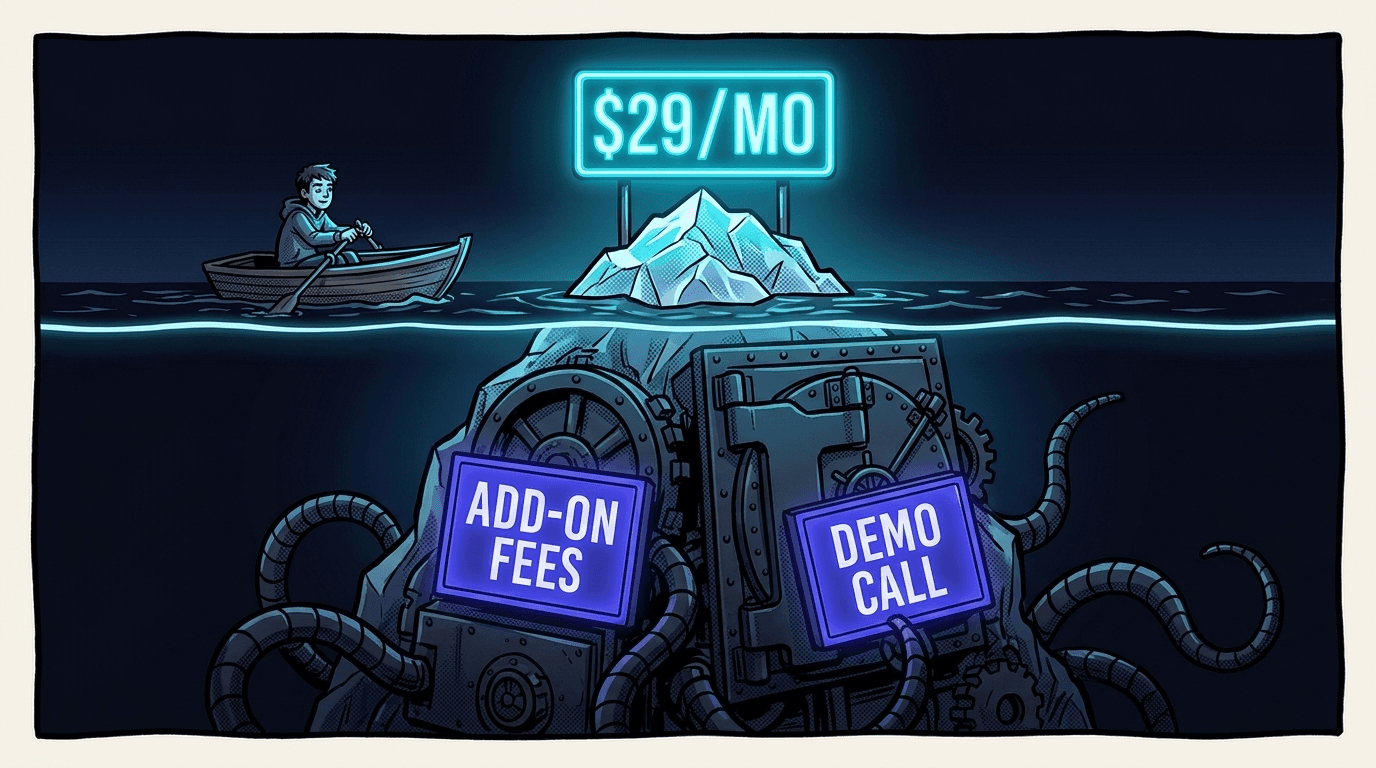
Answer Engine Optimization (AEO) costs anywhere from $0 for a one-time baseline audit, $12 to $295 a month for self-serve AI visibility tracking software, $699/mo or custom Enterprise fees for multi-model suites, up to $1,500 to $6,000+ a month if you hire an agency to rewrite pages and build off-site citations. The headline number on most pricing pages is misleading because vendors gate expensive models like Claude and Google AI Mode behind add-on fees, credit multipliers, or sales demos.
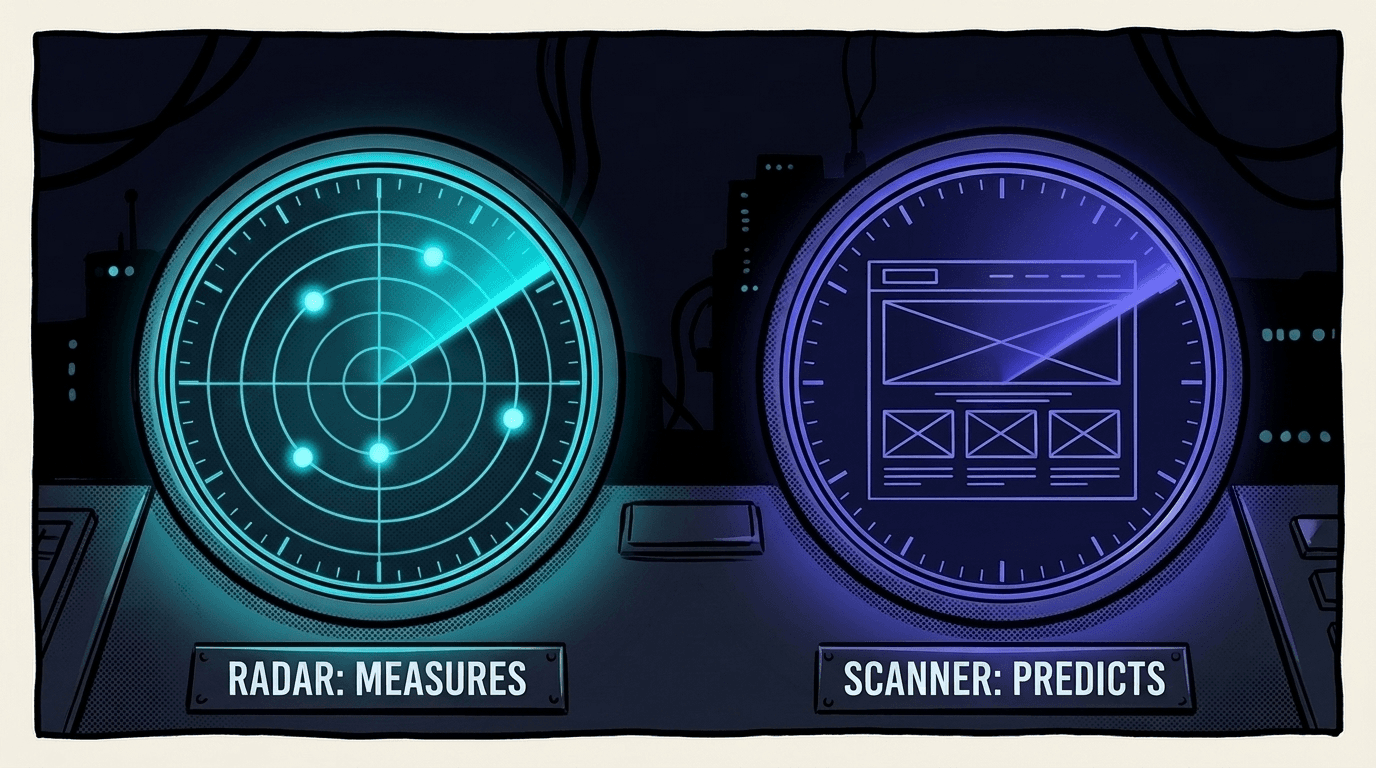
To compare costs fairly across the market, you have to separate three different purchases that buyers keep lumping together: on-page readiness checks (which predict whether crawlers and models can parse your page), weekly answer visibility trackers (which measure whether live AI engines actually cite or name your brand), and the implementation work itself. Here is what every tier costs in late 2026, where the hidden pricing cliffs sit, and how to pick the lowest-cost stack that actually answers whether your work drove citations.
How Much Does Answer Engine Optimization Cost in 2026?
Most teams overpay because they jump straight to enterprise monitoring or a $3,000/mo retainer before checking whether their own pages are even crawlable or where competitors win today.
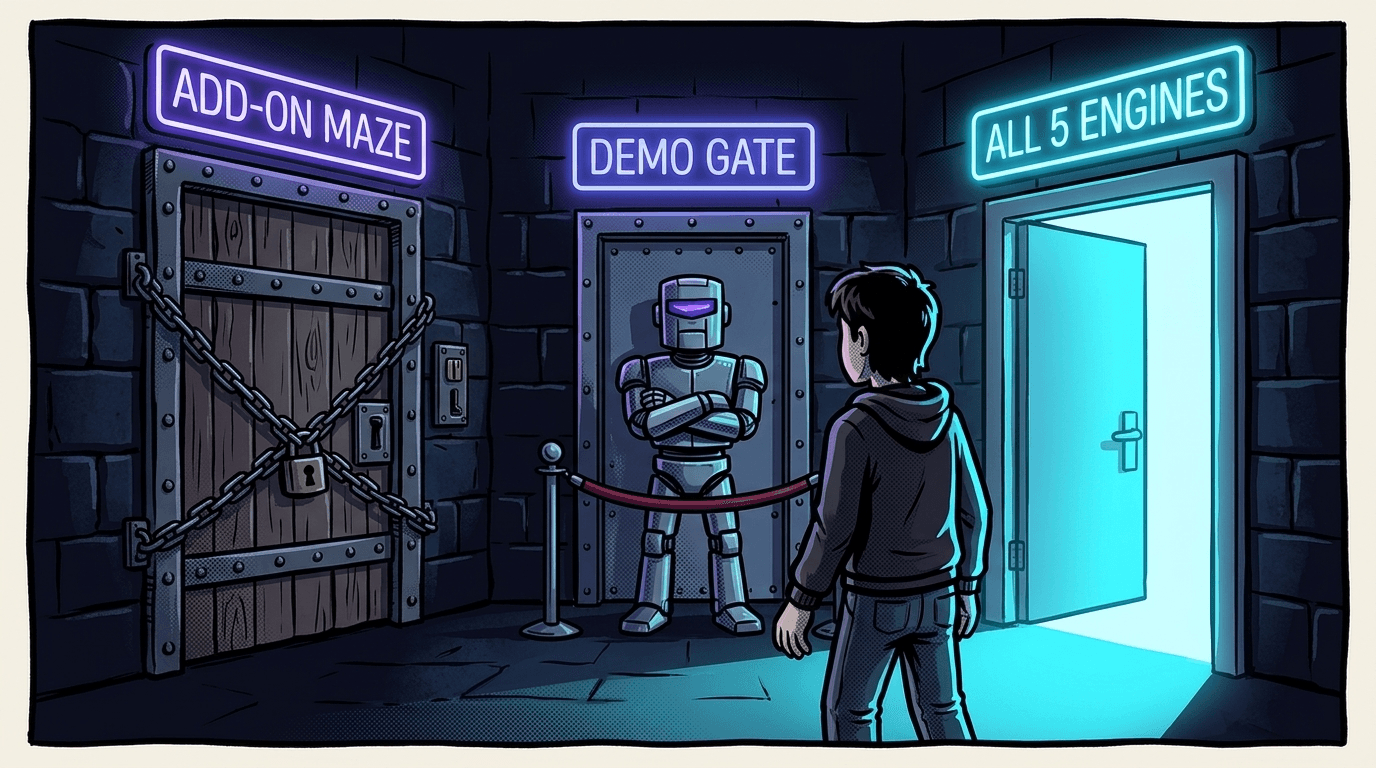
In practice, AEO spending falls into four clean budget tiers. Start at Tier 1 to establish a zero-dollar baseline, move to Tier 2 when you are ready to ship weekly content and third-party mentions, and step up to Tier 3 or Tier 4 only when you manage multiple client domains or outsource execution.
| Budget tier | Typical cost | What you get | Best for |
|---|---|---|---|
| 1. Free baseline & readiness checks | $0 | One-time AI visibility snapshots (up to 50 live answers on WhyIQ AI Radar across 5 engines, or brand-sentiment lookups on HubSpot and Ahrefs) plus 1st-page on-page AI Citability & 50-visitor CRO scan on WhyIQ CRO Scanner. | Validating demand, seeing which competitors hold your buyer prompts, and auditing your top landing page before spending. |
| 2. Self-serve SMB AI visibility software | $29 to $99/mo | Scheduled tracking across 15 to 50 prompts on 3 to 5 engines. WhyIQ AI Radar SMB starts at $12 for Month 1 at raw API cost, then $29/mo flat across all 5 engines (30 prompts weekly = 150 live answers/week). | SaaS founders, in-house marketers, and small teams shipping weekly page and third-party mention improvements. |
| 3. Multi-engine, suite add-ons & agency tools | $149 to $699+/mo | Multi-client workspaces, 100 to 350+ prompts, SEO suite bundles (Semrush from $165.17/mo annual, SE Ranking $89/mo add-on, Ahrefs Brand Radar $199 to $699/mo), or 3x multi-pass variance tracking and white-label reporting (WhyIQ Agency at $149/mo + $49/client). | Agencies billing client retainers, mid-market SEO teams, and buyers tracking high-stakes categories. |
| 4. Enterprise & done-for-you retainers | $1,500 to $6,000+/mo | Custom Enterprise platforms with CDN bot-traffic Agent Analytics (Profound, Peec Enterprise) or full-service agency retainers executing on-page rewrites, comparison pages, digital PR, Reddit/G2 presence, and CRO. | Teams with dedicated pipeline targets who want both measurement and execution handled externally. |
If you run a single B2B SaaS or service brand, software should never be your largest line item. Buying a $29/mo tracker and putting your remaining time or budget into crawlable pages, opening-third direct answers, and third-party brand mentions beats spending $500/mo on a dashboard nobody acts on.
What Are the Three Pricing Models for AI Visibility Tools?
When buyers compare AI search visibility platforms on price, they run into three distinct business models. Knowing which model a vendor uses tells you what your bill will look like six months in.
Model 1: Flat all-engines monthly pricing. You pay one transparent monthly fee based on prompt count or client workspaces, and every mainstream AI engine is included at the base tier. WhyIQ AI Radar uses this model: $12 for Month 1 at raw API compute cost (5 weekly scans x 30 prompts x 5 engines = 750 live answers), then $29/mo flat across ChatGPT, Perplexity, Claude, Gemini, and Google AI Mode with zero per-engine add-ons.
Model 2: Base subscription plus per-engine or suite add-ons. This is the most common surprise in AEO pricing. Because querying Anthropic's Claude and Google AI Mode with live web grounding costs significantly more per call than basic OpenAI or Gemini flash queries, vendors publish an attractive $29 to $95 entry price on 3 or 4 engines and charge extra for the rest. Otterly.AI advertises $29/mo Lite for 15 prompts across 4 engines, then bills Claude, Gemini, and Google AI Mode as separate add-ons from $9 up to $439/mo. Ahrefs includes 150 to 600 checks/mo inside paid SEO plans ($129/mo+), where Claude consumes 8 checks per update versus 1 for other engines, and its full 551M-prompt Brand Radar index jumps to $199/mo per model or $699/mo for all models.
Model 3: Credit-metered or demo-gated Enterprise pricing. Tools targeting larger brands or procurement teams either price every AI response against a monthly credit pool (AthenaHQ's Essential Free tier gives 300 credits, then Starter jumps to $295/mo for 3,600 credits across 11 models) or hide paid tiers behind a sales demo (Profound offers a free 7-day 3-engine trial with no exports or history, then custom Enterprise contracts for up to 9 engines and CDN-level Agent Analytics).
77.6% vs 2.2%
Brand-owned content appears in 77.6% of AI answers to branded questions, but captures only 2.2% of citations on unbranded buyer discovery queries. Foundation and AirOps, 57.2M-citation study, 2026
Key takeaway
Never compare two AEO pricing pages by headline dollar figure alone. Normalize every quote to the monthly cost of running unbranded buyer questions across all five mainstream engines (ChatGPT, Perplexity, Claude, Gemini, and Google AI Mode).
What Do 9 Major AEO Platforms Cost Across All 5 Engines?
Side-by-side pricing and engine coverage across nine major AEO and AI visibility tools, verified from public vendor pages on 9 November 2026 (and 3 November 2026 for suite and enterprise tiers).
| Platform | Published entry price | Engines at entry | Real 5-engine / full-scope cost | Cadence & sampling |
|---|---|---|---|---|
| WhyIQ AI Radar | $12 Month 1, then $29/mo (SMB, 30 prompts) | $0 free 50-answer check | 5 engines: ChatGPT, Perplexity, Claude, Gemini, Google AI Mode | $29/mo flat ($149/mo Agency for 3x weekly runs + white-label) | Weekly (3 runs per prompt/engine on Agency) |
| Otterly.AI | $29/mo (Lite, 15 prompts) + free trial | 4: ChatGPT, Perplexity, AI Overviews, Copilot | Add-ons for Claude, Gemini & AI Mode ($9 to $439/mo); Standard is $189/mo | Daily (single run) |
| HubSpot AEO | $50/mo (after free 1-time AI Search Grader) | 3: ChatGPT, Perplexity, Gemini | Does not include Claude or Google AI Mode | Brand grade on training data (free); ongoing tracker ($50/mo) |
| SE Ranking (SE Visible) | $89/mo ($71.20/mo annual) add-on on an SE Ranking plan (200 prompts) | 4: ChatGPT, Perplexity, AI Overviews, AI Mode | Requires core SE Ranking plan (or standalone SE Visible); no Gemini in add-on | Daily |
| Peec AI | $95/mo (EUR 85/mo) Starter (50 prompts) | 3 models of your choice | 5+ engines require custom Enterprise pricing (up to 13 models) | Daily |
| Semrush | $165.17/mo billed annually (Starter, 50 prompts) | 5: Google AI Overviews, AI Mode, ChatGPT, Perplexity, Gemini | Includes 5 surfaces; omits native Claude tracking | Daily |
| Ahrefs Brand Radar | 150 to 600 checks/mo in Ahrefs ($129/mo+); standalone from $50/mo Custom Prompts | 5 in public preview; Claude burns 8 checks per update in paid suite | $199/mo per model or $699/mo all models for full 551M-prompt index | Daily / credit-metered |
| AthenaHQ | Essential Free (300 credits), then $295/mo Starter ($95 first month) | 5 free (no Claude or AI Mode); 11 models at $295/mo Starter | $295/mo Starter (3,600 credits; 1 credit = 1 AI response) | Credit-metered (cadence not stated on pricing page) |
| Profound | Free 7-day trial (50 prompts/day), then custom Enterprise via demo | 3 on trial: ChatGPT, Gemini, AI Overviews (no Perplexity or Claude) | Custom Enterprise sales quote (up to 9 engines + CDN Agent Analytics) | Daily |
Where competitors justify higher price tags. Paying more is rational when you need capabilities outside weekly prompt tracking. If your enterprise security team requires SOC 2, SSO, and Cloudflare or Akamai CDN log ingestion to measure bot traffic hitting your servers (Agent Analytics), Profound is built for that job and WhyIQ does not compete there. If your team already pays $129/mo+ for Ahrefs or $165.17/mo for Semrush and only wants a quick brand baseline alongside backlink data, check the included checks in your existing suite before adding another tool.
And when another option beats WhyIQ on price-fit: pick HubSpot AEO ($50/mo) if you only care about ChatGPT, Perplexity, and Gemini inside a HubSpot workflow; pick Otterly.AI ($29/mo Lite) if Microsoft Copilot is a core channel for your buyers; pick SE Ranking ($89/mo add-on, or $71.20/mo annual) if you already run client reporting in SE Ranking and want 200 prompts daily; or use our 6 free AI visibility checkers guide before paying any vendor. For a deeper feature-by-feature table, see our 7-tool AEO software breakdown.
Is an AEO Tool Worth the Subscription Cost? The 7-Point Rubric
Buying an AEO tool only pays off when the tool separates real visibility movement from LLM sampling noise and points you to the exact blocker. Use these seven checks before subscribing.
1. Unbranded buyer prompt coverage vs. brand vanity. As Foundation and AirOps measured across 57.2 million citations (2026), your own site appears in 77.6% of answers to questions that name your brand, versus 2.2% of citations on unbranded category searches. A cheap check that queries your brand name flatters your score while hiding which competitor wins the buyer shortlist.
2. Full 5-engine coverage at your actual budget. Confirm that ChatGPT, Perplexity, Claude, Gemini, and Google AI Mode are all included in the price tier you are approving, because each engine pulls from different indexes and sources.
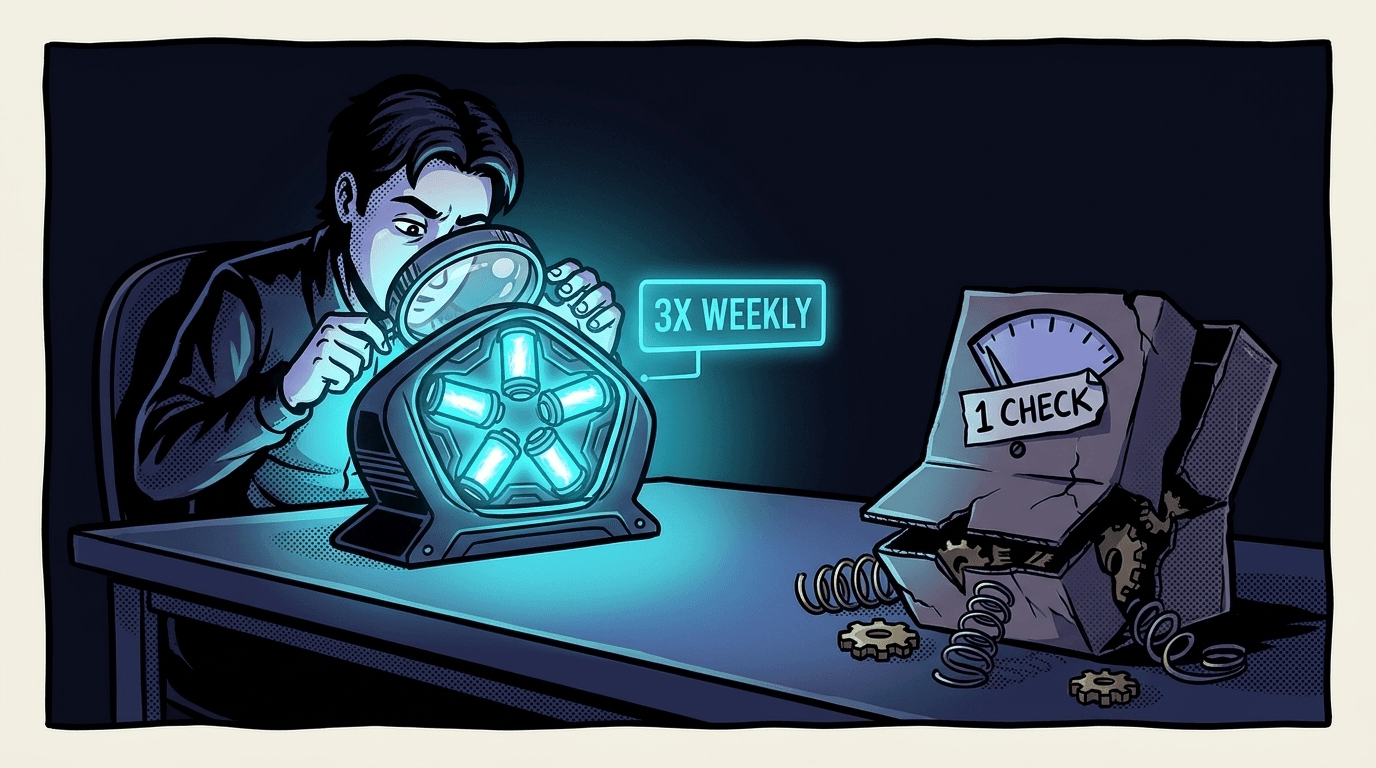
3. Sampling cadence and multi-run variance. Ask the exact same prompt twice and the cited URLs shift. In AirOps' 2026 visibility study, only 30% of brands stayed consistently visible from one run to the next, and Profound found 40 to 60% of cited domains turn over month to month (June vs. July 2025). Running a handful of prompts once a month mistakes single-roll luck for trendlines. That is why WhyIQ AI Radar runs weekly (30 prompts on SMB, or 40 prompts x 5 engines x 3 runs = 600 weekly queries per client on Agency reporting stability like "linked in 2 of 3 runs").
40 to 60%
of the domains cited by ChatGPT, Perplexity, and Google AI Overviews change from one month to the next. Profound citation volatility tracking, 2025
4. Cited-link vs. brand-mention split and third-party domains. Good platforms separate Cited (linked as a source) from Mentioned (named in text without a link) and show which external reviews, Reddit threads, or comparison posts beat you. Across AirOps' 2026 dataset, 85% of brand mentions came from external domains and brands were 6.5x more likely to be cited through third parties than through their own domain, while Ahrefs (2025, 75,000 brands) measured brand mentions correlating with AI Overviews at r=0.664 (~3x backlinks at r=0.218) and extended the 0.66 to 0.71 range across ChatGPT and AI Mode.
5. Historical lookback and 2-week fix verification. A tracker should tell you whether last month's page update actually worked. WhyIQ AI Radar tracks shipped fixes across up to 8 post-ship weekly scans and marks a fix Won only after two consecutive weekly scans confirm the engine cites your page.
6. Agent Analytics vs. Answer Visibility (and CDN traps). Enterprise suites use "Agent Analytics" to mean server or CDN logs tracking bot visits (OAI-SearchBot, Claude-SearchBot, PerplexityBot). Answer visibility tools track what the model actually says to buyers. Before paying any subscription, check your robots.txt, Search Console "Search generative AI" setting (Include), and CDN rules: since 15 September 2026, Cloudflare's Training "Block" setting can also stop Googlebot (use "Disallow AI Training" instead), and disallowing Google-Extended affects Gemini grounding as well as training.
7. True price-to-quality ratio. Divide your real monthly invoice (after add-ons) by the number of verified weekly answers across all 5 engines. On WhyIQ AI Radar SMB ($29/mo), 600 to 750 monthly answers across 5 engines costs roughly $0.04 to $0.05 per live answer, with Month 1 priced at $12 (our raw compute bill).
How Should Agencies Price AEO and GEO Retainers in 2026?
Agencies looking for affordable AEO tooling face two math checks: what the software costs per client domain, and what retainer keeps delivery profitable once content and PR hours are included.
Across B2B SEO and CRO agencies, standalone AEO/GEO retainers typically price at $1,500 to $3,500/mo per client (or as a $500 to $1,500/mo expansion add-on to an existing SEO or CRO scope). On the tooling layer, WhyIQ AI Radar Agency costs $149/mo including your first client domain, plus $49/mo for each additional client domain ($490/yr annual per extra domain). At 5 clients, your monitoring bill is $345/mo ($69/client); at 10 clients, it is $590/mo ($59/client) for 40 prompts x 5 engines x 3 weekly runs = 600 live queries per client every week and a white-label weekly report link (/rr/[token]).
Pair that with WhyIQ CRO Scanner Agency at $249/mo (150 page scans/month, multi-page site scans up to 25 pages, and white-label PDF reports) and a 10-client agency keeps its entire 5-engine AEO measurement + 4-pillar on-page audit stack at $839/mo total ($83.90 per client), leaving 90%+ gross margin on a $1,500+/mo retainer to fund actual page rewrites, comparison content, and third-party placements. See our agency AEO packaging playbook for proposal templates and the 4-to-8-week timeline clause.
How to Audit Readiness and Measure Visibility Today for $0
Before spending $29/mo or $2,000/mo on an agency, separate what happens inside the AI engines from what happens on your own URLs.
Step 1: Measure live AI visibility ($0 baseline check). WhyIQ AI Radar measures real weekly AI visibility (Cited links plus Mentioned brand names) across ChatGPT, Perplexity, Claude, Gemini, and Google AI Mode. Run one free check on WhyIQ AI Radar with 9 unbranded buyer questions plus 1 brand question (50 live answers in up to 10 minutes, email only, open for 30 days). If you need ongoing weekly tracking afterward, Month 1 is $12 at raw API cost, then $29/mo flat.
Step 2: Predict on-page readiness and conversion friction ($0 first scan). The WhyIQ CRO Scanner is a separate instrument: it predicts on-page readiness heuristically through an 8-signal AI Citability Index (never claiming to measure live LLM citations) and runs 50 simulated visitors across 21 archetypes through your page to score Clarity, bounce rate, and CTA Pull (0 to 100). Your first page scan is free with your email; unlocking every element-level fix and build prompt is $9 once (first-scan promo off the $19 list price, credits never expire) or $0 when you connect your verified site via 1-click WhyIQ Autopilot (/mcp) under our 4-Mode Switchboard and our [fill in: ...] Honesty Gate.
Run the free 50-answer check to see which competitor holds your buyer prompts, fix the page gaps with a single scan, and pay for weekly tracking only when you are ready to measure the lift.
Frequently asked questions
How much does Answer Engine Optimization (AEO) cost in 2026?
In 2026, AEO breaks into four budget tiers: $0 for baseline one-time checks (such as WhyIQ AI Radar's 50-answer free check or HubSpot's brand grader) and free on-page readiness previews; $29 to $99/mo for self-serve SMB AI visibility software (WhyIQ AI Radar is $12 in Month 1 at raw API cost, then $29/mo flat across 5 engines); $149 to $699+/mo for multi-client agency tools, multi-pass stability, or enterprise add-ons; and $1,500 to $6,000+/mo for done-for-you agency retainers covering technical fixes and third-party PR.
What are the three pricing models for AI search visibility platforms?
Vendors price AI search monitoring in one of three ways: (1) flat all-engines monthly subscriptions, where every paid plan covers the core answer engines without add-on taxes (WhyIQ AI Radar at $29/mo SMB or $149/mo Agency); (2) base price plus per-engine, per-domain, or suite add-ons, where entry plans omit Claude, Gemini, or Google AI Mode until you pay extra (Otterly.AI, SE Ranking, Ahrefs Brand Radar, Semrush); and (3) credit-metered or demo-gated Enterprise tiers (AthenaHQ at $295/mo, Peec AI above 3 models, and Profound after its 7-day trial).
Why does a $29/month AEO tool often end up costing much more?
Entry tiers in this category are frequently priced on 3 or 4 cheaper models rather than all 5 mainstream answer engines. Adding Claude or Google AI Mode triggers per-engine add-ons ($9 to $439/mo at Otterly.AI), heavier credit multipliers (Claude burns 8 checks per update on Ahrefs vs 1 for other models), or jumps to $189 to $295+/mo tiers. Always normalize vendor pricing to the cost of tracking your target prompt list across ChatGPT, Perplexity, Claude, Gemini, and Google AI Mode together.
Is an Answer Engine Optimization tool actually worth the subscription cost?
An AEO tracker is worth the subscription only if you pair measurement with action. Because AI search is probabilistic, only 30% of brands stay consistently visible from one run to the next (AirOps, 2026) and 40 to 60% of cited domains turn over monthly (Profound, 2025). Tracking unbranded buyer questions weekly tells you which competitor took the slot, which third-party domain the engine trusted, and whether a fix held across two consecutive weekly scans. Running a tracker without changing pages or third-party mentions buys an expensive scoreboard.
How do you evaluate AI visibility and Agent Analytics products for price-to-quality ratio?
Score any product across seven dimensions: (1) unbranded buyer prompt coverage versus branded vanity prompts, (2) full 5-engine coverage without add-on fees, (3) sampling rigor (weekly multi-run variance versus noisy single-shot checks), (4) cited-link vs brand-mention separation and third-party domain attribution, (5) historical proof and 2-week post-fix verification, (6) whether you need server-side CDN bot-traffic logs (Agent Analytics) or prompt-level answer visibility, and (7) total monthly cost for all 5 engines.
How should marketing agencies price AEO and GEO services?
Most agencies bundle AEO and GEO into $1,500 to $3,500/mo retainers or add $500 to $1,500/mo onto existing SEO and CRO retainers. On the software side, WhyIQ AI Radar Agency is $149/mo for the first client plus $49/mo per additional client ($59/client/mo across 10 clients for 40 prompts x 5 engines x 3 weekly runs = 600 queries/client/week plus white-label client reports), while WhyIQ CRO Scanner Agency is $249/mo for 150 page scans and multi-page site audits. That keeps software costs under 5% to 10% of the monthly client fee.
What is the difference between an on-page AI Citability scan and weekly AI visibility tracking?
They answer opposite sides of the problem. WhyIQ CRO Scanner predicts on-page readiness heuristically via an 8-signal AI Citability Index (plus a 50-visitor behavioral simulation for Clarity and CTA Pull), with your first page scan free with your email and $9 introductory full unlocks ($19 list). WhyIQ AI Radar measures actual weekly AI visibility (Cited links plus Mentioned brand names) across live answers from ChatGPT, Perplexity, Claude, Gemini, and Google AI Mode, starting with a $0 50-answer check and $12 Month-1 SMB tracking.
Go deeper
Compare individual tool limits in our 7-vendor AEO software comparison, test the zero-dollar options in 6 free AI visibility checkers compared, or read how to package client retainers in how agencies sell AEO and GEO services.